Read Time:
2-3 Mins

A Pharmaceutical Company's Journey to YoY Hiring Success with a Unified Platform

By
CBREX

A global pharmaceutical company aimed to digitize its recruitment process to support its ambitious growth plans, but it faced several familiar hiring challenges. A successful partnership with a new platform paved the way for some resounding results.

Challenge 01: Vendor Management Friction

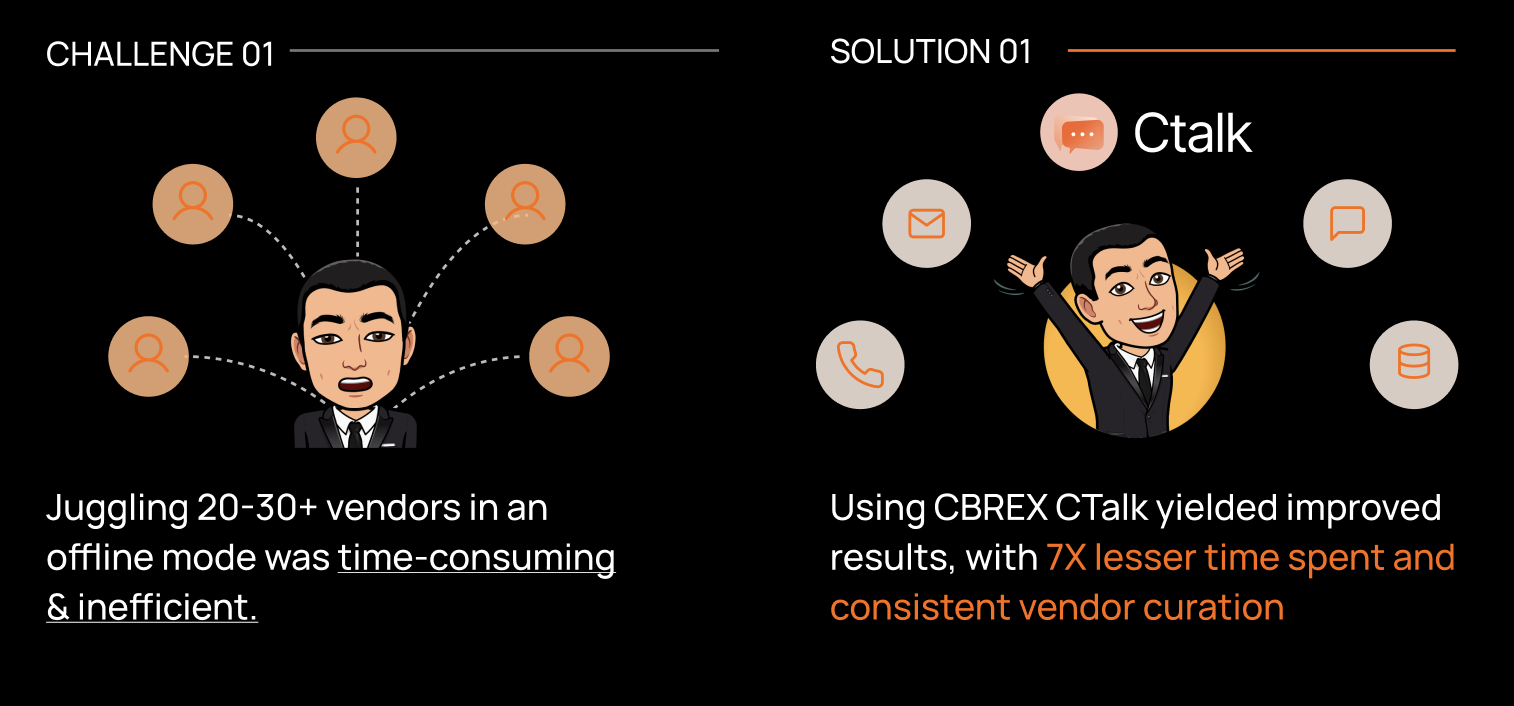
The company was manually managing a network of over 20–30 vendors, a process that was time-consuming and inefficient. This decentralized approach made it difficult to maintain consistent vendor curation and communication, often leading to a “long tail of low-performing agencies.”

Solution 01: A Centralized Communication Hub
By using a built-in communication tool, the company achieved improved results, spending 7x less time on vendor management. This centralized communication hub organized and controlled the influx of calls and emails, allowing recruiters to respond on their preferred schedule and make more confident hiring decisions. A single platform eliminates the need to use multiple channels like emails and phone calls for communication with vendors.
Challenge 02: Sourcing in Tough-to-Hire Regions

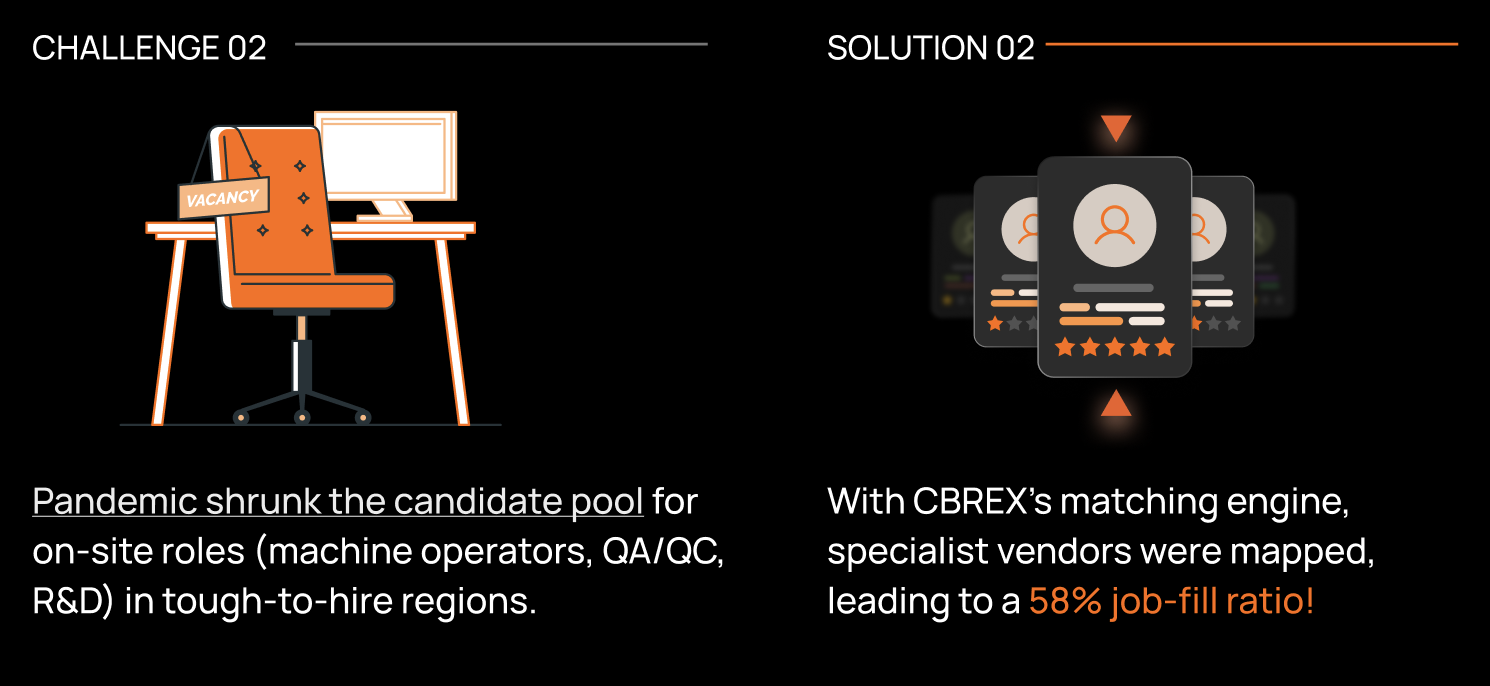
The pandemic shrank the candidate pool for on-site roles like machine operators, QA/QC, and R&D in tough-to-hire regions. These hard-to-fill roles often led to longer turnaround times and higher recruitment costs.

For this company, locations such as Fall River, MA; Central Islip, NY; and Hauppauge, NY posed particularly tough sourcing challenges. The positions they needed to fill spanned across critical areas of pharmaceutical operations, including:

  • QA/QC, Quality Assurance, Analytical QA Associate, and QA Inspector
  • QC Glass Cleaning Technician, QC Lab Tech
  • Manufacturing Operator (FBD, Encapsulation, Coating), Packaging Operator
  • Warehouse Operator, Facilities Maintenance Engineer
  • Senior Accountant

These roles, spread across technical, operational, and support functions, required a broad spectrum of specialized skills—making traditional hiring methods even more complex.

Solution 02: An AI-Powered Matching Engine
By leveraging a platform with an AI-matching engine, specialist vendors were automatically mapped to open roles, leading to a 58% job-fill ratio. The platform acted as a “one-stop-shop” for posting positions across all levels and skills. This curated network of specialist agencies, combined with a multi-level screening process, ensured that only qualified candidates were presented.
Challenge 03: Skyrocketing Hiring Costs

Hiring costs, particularly for executive search roles, posed a significant challenge. Without a unified view of vendor performance, it was easy to pay high fees for low-quality candidates.

Solution 03: Bottom-Line Savings
The partnership helped the company reduce vendor costs by 31%, resulting in significant bottom-line savings. Vendor consolidation helped optimize recruitment spending within an automated system, providing more granular control over costs. It also enabled more favorable rate negotiations and improved operational efficiency.

The Outcome

Today, a significant share of the company’s vendor hiring in North America is managed through the platform’s VMS, setting the stage for a global VMS model. From QA/QC specialists in Fall River, MA to manufacturing and packaging operators in Central Islip, NY, and analytical QA associates in Hauppauge, NY, the platform has proven to be a reliable partner in filling both volume and niche positions.

By digitizing recruitment across diverse job categories—from lab technicians to accountants—the company was able to improve hiring speed, cut costs, and ensure consistency in quality. This unified hiring approach now enables the company to staff even its toughest roles with confidence and efficiency, laying the groundwork for scalable global growth.

Table of contents

Sign up for regular updates
Get all the news delivered to your inbox.
Thank you! Your submission has been received!
Oops! Something went wrong while submitting the form.

Similar blogs

Read Time :
3 Mins
One Dashboard, 5,000 Agencies: The CFO’s Guide to Recruitment Convenience
In 2026, CFOs are prioritizing efficiency and eliminating operational complexity across the organization. Managing dozens or even hundreds of recruitment vendors creates unnecessary legal, financial, and administrative burdens. The recruitment exchange model offers a smarter alternative by consolidating vendor relationships into a single platform with one Master Service Agreement. This “single-pane-of-glass” approach enables organizations to access thousands of specialized agencies without the overhead of managing multiple contracts, invoices, and systems—transforming recruitment into a streamlined, predictable, and high-output function.
Read Time :
3 Mins
The Accuracy Arbitrage: Why Precision-Vetting is the Only Cure for 2026’s Resume Inflation
In 2026, AI-driven auto-applications have flooded the recruitment funnel, making it harder than ever to identify truly qualified candidates. Resume inflation means that many candidates appear perfect on paper but lack real-world expertise. Precision vetting is emerging as the solution, shifting recruitment from volume-based sourcing to accuracy-driven filtering. By combining technical validation and behavioral analysis, AI-powered recruitment exchanges help organizations cut through noise, verify candidate capabilities, and focus only on high-quality, high-intent talent—transforming hiring into a more efficient and reliable process.Executive Summary: As AI "agents" begin to auto-apply to thousands of roles simultaneously, the traditional recruitment funnel has collapsed under the weight of 5,000+ resumes per job. This post explores the Accuracy Arbitrage—the competitive advantage of using the CBREX exchange to replace "Volume-based" sourcing with High-Precision Filtering. The 2026 Crisis: The "Bot-Flood" and Resume Inflation If you posted a Senior Developer role today, you didn't just invite talent; you invited an army of bots. In 2026, Agentic AI tools can "perfect" a resume and apply to 500 jobs in under 60 seconds. This has led to Resume Inflation—where every candidate looks like a 10/10 on paper, but only 0.1% possess the actual technical depth required. For the modern HR leader, the cost of "Finding" has dropped to zero, but the cost of "Verifying" has skyrocketed. The Senior Insight: In a world of infinite noise, Accuracy is the only premium. The companies that win the talent war in 2026 aren't the ones who see the most resumes; they are the ones who see the right five. How can enterprises use precision-matching to eliminate AI-generated application noise? To beat the "Bot-Flood," you cannot use a bigger bucket (more recruiters); you need a finer mesh (better data). Precision-matching requires a shift from Keyword Recognition to Proven Capability. The CBREX exchange model solves this by utilizing Accuracy & Precision as its core architecture. Instead of a generalist algorithm, the exchange routes requirements to specialized micro-vendors who possess the "Human-in-the-Loop" expertise to spot an AI-hallucinated skill set from a mile away. The Precision Filter: CSCREEN & CPREDICT While job boards offer "matches," CBREX offers "Guaranteed Signal." CSCREEN (The Technical Anchor): This isn't just a quiz. It’s a high-precision validation layer that uses live environment testing to ensure a candidate’s "Rust" or "Cybersecurity" expertise is real. CPREDICT (The Intent Anchor): It analyzes behavioral data to distinguish between a "Bot-Applied" candidate and a "High-Intent" professional. It predicts the likelihood of the candidate actually showing up for the interview. Volume vs. Veracity: The 2026 Benchmarks Data from the CBREX exchange highlights why "Accuracy" is the ultimate ROI lever.
Read Time :
3 mins
How AI-Powered Vendor Matching Reduces 'Time-to-Shortlist' by 40%
In competitive technical hiring markets, speed is critical. The most important recruitment metric today is no longer time-to-fill but time-to-shortlist — the speed at which qualified candidates reach hiring managers. Traditional agencies often rely on manual database searches, which slows down the process and results in outdated candidate matches. AI-powered recruitment exchanges solve this challenge by instantly matching job requirements with specialized vendors who already have access to relevant talent pools. Combined with automated sourcing and technical validation tools, this model dramatically reduces the time needed to produce high-quality candidate shortlists.