Read Time:

AI in Niche Hiring: Finding the Needle in the Haystack

By
CBREX

Some roles are easy to fill. Others? They require rare skills, niche expertise, or experience that is hard to find — and that makes recruiting them a real challenge.

AI is quietly helping recruiters tackle these “needle in the haystack” hires, enabling precision and efficiency without replacing human judgment.

A real-world example: hiring rare expertise

A biotech company was looking to hire specialized researchers with rare skill sets across multiple regions. Traditional sourcing methods were slow, and recruiters spent weeks scanning resumes and networks with limited success.

By implementing AI-driven talent matching, the team was able to identify candidates whose skills, experiences, and career trajectories aligned with the role — even if their resumes didn’t contain exact keyword matches. AI filtered large databases and surfaced profiles that recruiters might have missed, giving them curated shortlists to evaluate further.

The result? A faster, more precise hiring process, with recruiters focusing on the evaluation, engagement, and relationship-building that machines cannot do.

How AI supports niche hiring

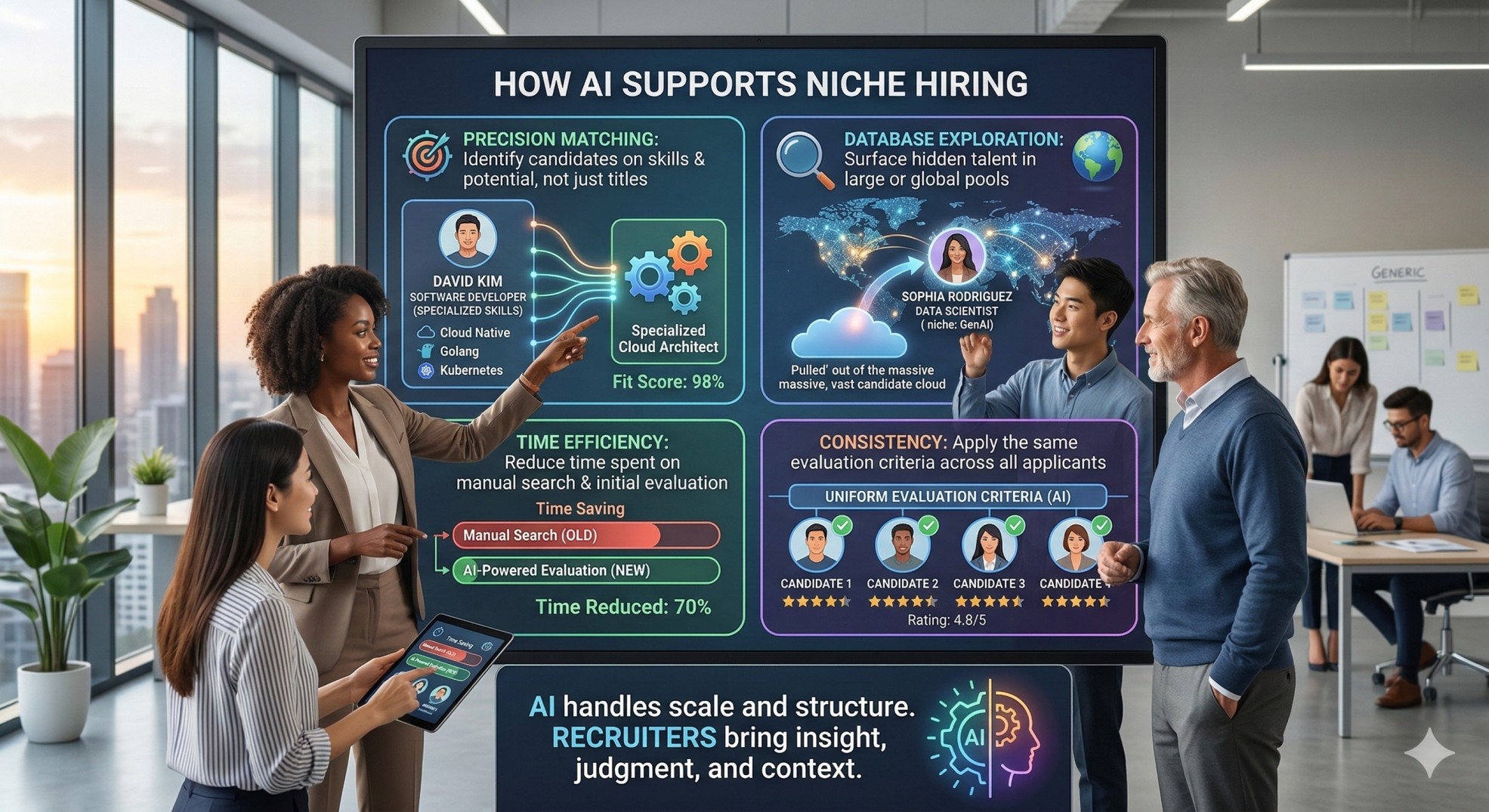
Recruiters handling specialized roles consistently find AI helps in several ways:

  • Precision matching: Identify candidates based on skills and potential, not just titles.

  • Database exploration: Surface hidden talent in large or global pools.

  • Time efficiency: Reduce time spent on manual search and initial evaluation.

  • Consistency: Apply the same evaluation criteria across all applicants.

AI handles scale and structure, while recruiters bring insight, judgment, and context.
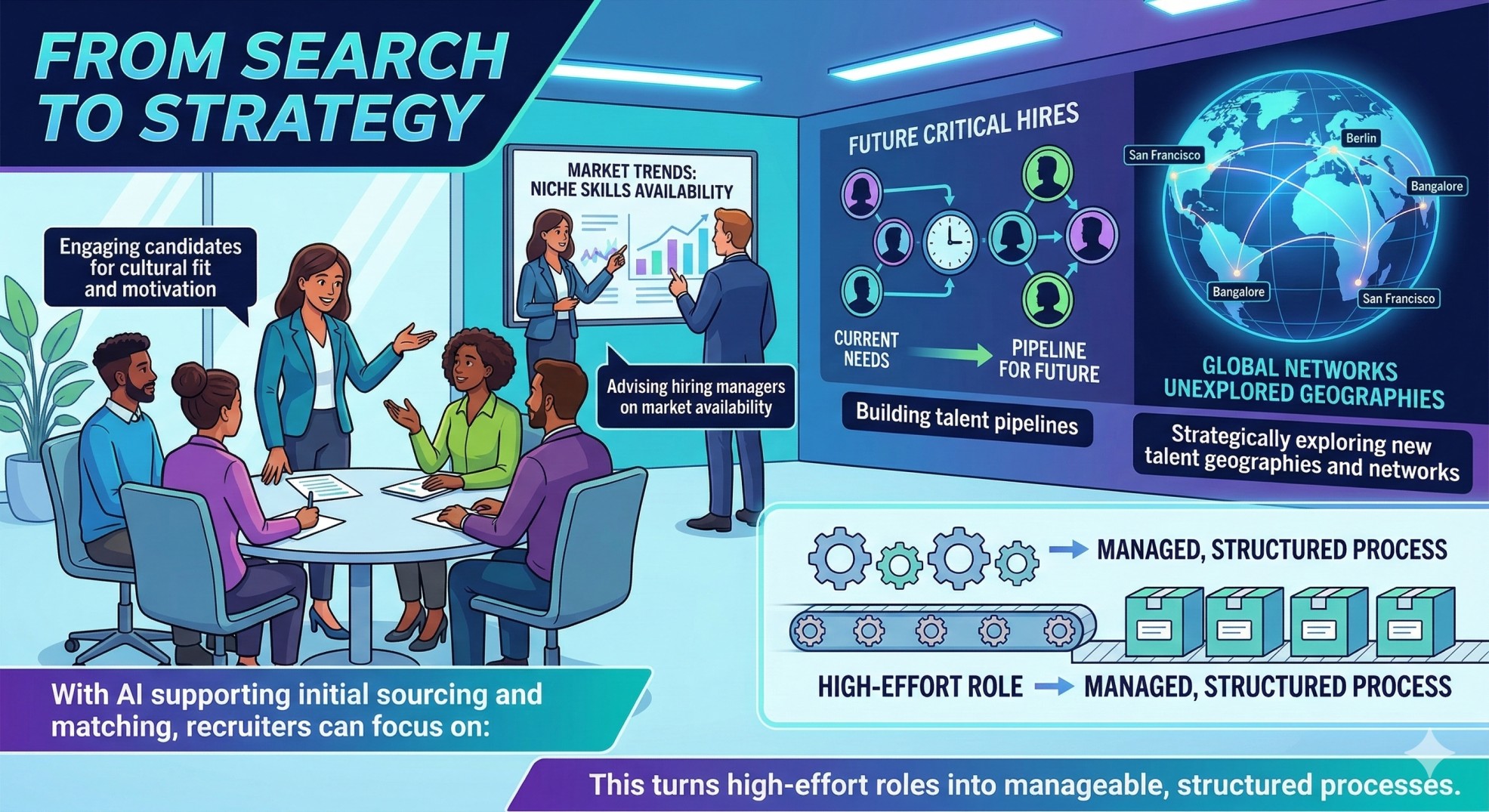
From search to strategy

With AI supporting initial sourcing and matching, recruiters can focus on:

  • Engaging candidates for cultural fit and motivation.

  • Advising hiring managers on market availability of niche skills.

  • Building talent pipelines for future critical hires.

  • Strategically exploring new talent geographies and networks.

This turns high-effort roles into manageable, structured processes.
Type image caption here (optional

A quiet role for platforms in niche hiring

Platforms like CBREX subtly enhance this process by organizing candidate data and surfacing relevant talent while leaving decision-making entirely in recruiters’ hands.

AI handles the background complexity, but human judgment guides final selection — ensuring that quality and fit remain paramount.

The takeaway

Niche hiring doesn’t have to be overwhelming.

AI makes it possible to focus on precision rather than volume, helping recruiters find the right candidate faster while maintaining full control over decisions. In the future of specialized recruitment, humans and AI work together — each bringing what they do best to the table.

Table of contents

Sign up for regular updates
Get all the news delivered to your inbox.
Thank you! Your submission has been received!
Oops! Something went wrong while submitting the form.

Similar blogs

Read Time :
2 Mins
Time-to-Productivity: The Hidden ROI of Technical Accuracy
In 2026, Time-to-Productivity (TTP) has replaced speed as the vital hiring metric. AI-driven recruitment exchanges boost this by using precision vetting and standardized assessments to ensure technical accuracy. By focusing on verified skills, organizations reduce costly "false positive" hires, accelerating onboarding and protecting overall ROI.
Read Time :
3 MINS
The "Recruiter Seat" Tax: Lowering Software Op-Ex in 2026
To cut "Recruiter Seat Tax" in 2026, firms are ditching costly SaaS licenses for recruitment exchanges. This shift replaces high software spend with outcome-based hiring, using one platform to access global talent and specialized vendors more efficiently.
Read Time :
2 Mins
The Recruitment Purge: Consolidating 100+ Vendors into One Platform
Managing fragmented recruitment vendors in 2026 creates costly administrative bottlenecks. The recruitment exchange model solves this by consolidating multiple contracts and data streams into a single platform under one Master Service Agreement. By centralizing procurement and utilizing AI-driven matching, organizations reduce operational friction, gain clear performance visibility, and scale hiring efficiently without losing access to specialized talent.