Read Time:
3 Mins

The Death of the 'Generalist' Agency: Why 2026 Demands a Recruitment Exchange Model

By
CBREX

At a Glance: In 2026, AI has made “finding” candidates easy but “hiring” them harder due to high application noise. This post explores why the Recruitment Exchange model is replacing generalist agencies by focusing on Filtering over Sourcing, resulting in a 40% increase in offer-acceptance and 90% faster technical screening.

The Paradox of AI Sourcing: Why “Finding” is No Longer the Goal

In the pre-AI era, the recruiter’s value was in finding the candidate. Today, AI tools make it so easy to find and apply for jobs that recruiters are drowning in “perfect-looking” resumes that lack substance.

This is the 2026 Recruitment Paradox: Because AI makes it easier to apply, it has become significantly harder to hire. In this landscape, the value of a recruiter has shifted from Sourcing to Filtering. If your agency is still boasting about the size of its database, they are selling you a bucket of water in a flood. You don’t need more resumes; you need a high-precision filter.

Case Study: High-Complexity Tech Hiring in a Multi-Region Market

Consider a multi-national FinTech firm specializing in digital lending and cross-border payments. In early 2025, they aimed to hire 50+ Senior Backend Engineers (Golang/Rust) across three time zones (EMEA, APAC, and AMER).

Their traditional “Tier 1” generalist agencies failed. Why? Because a generalist recruiter lacks the niche depth to distinguish between an engineer who uses AI and one who can build high-concurrency financial architecture. The internal team was spending 15 hours a week per recruiter on technical interviews for candidates who looked great on paper but failed at the whiteboarding stage.

The Pivot to the Exchange Model:

By moving to a Recruitment Exchange, the firm stopped relying on one “do-it-all” partner. Instead, the requirement was intelligently routed to four hyper-specialized micro-vendors who lived and breathed high-load FinTech. The result was a 40% increase in offer-acceptance rates because the candidates were pre-vetted for specific technical nuances and cultural fit before the first interview.

The Efficiency Gap: Reclaiming the Recruiter’s Day

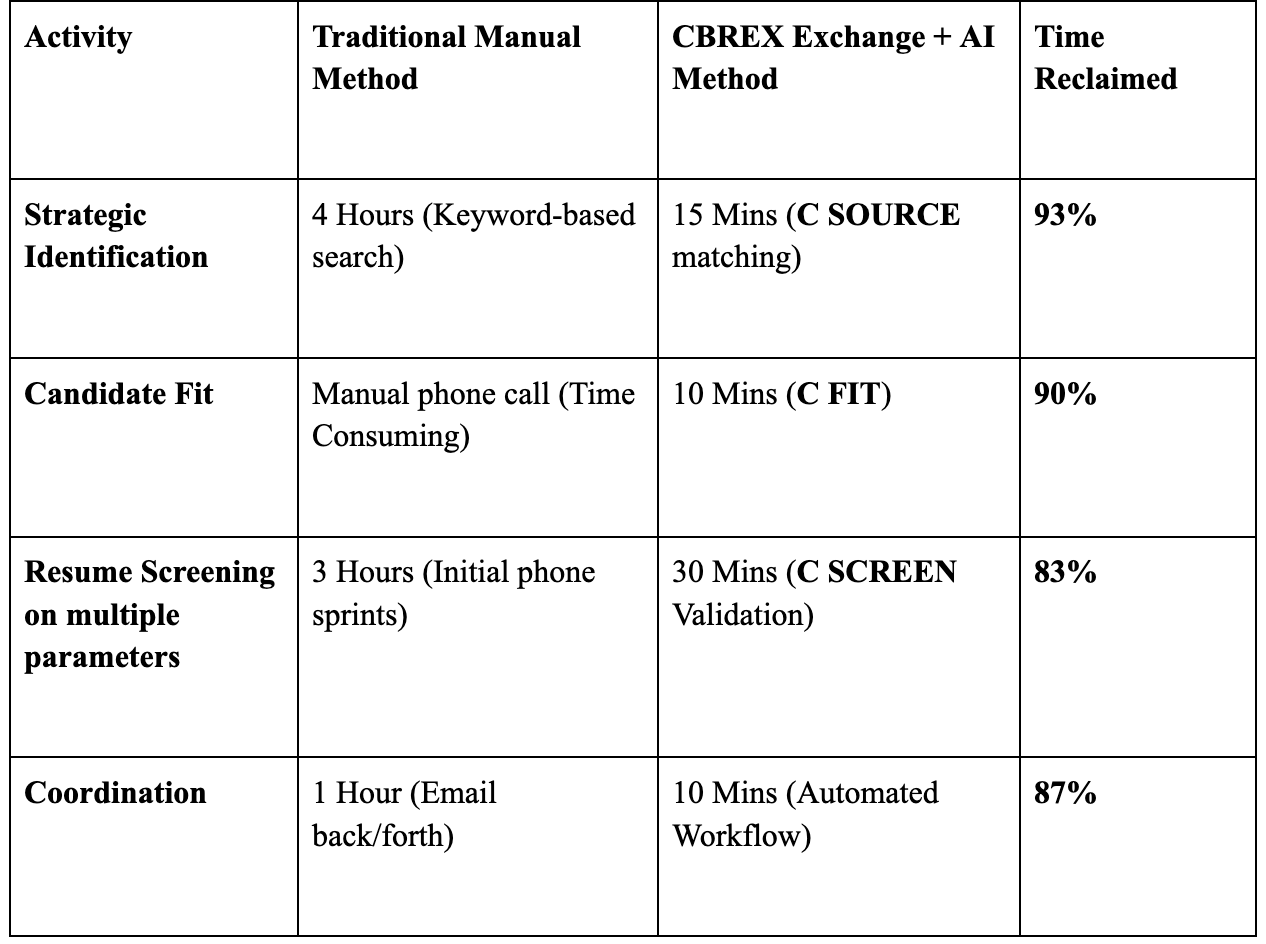
The primary reason generalist agencies are dying is that they cannot match the speed of an AI-integrated exchange. High-signal data shows exactly where the time is recovered:
The Bridge: From Specialist Vendors to Global Scale

The gap between a “lucky hire” and a “predictable hire” is the technology stack used by the vendor. This is why the CBREX model has become the 2026 standard for enterprise talent acquisition.

When a client posts a requirement on the exchange, CBREX doesn’t just “look for resumes.” It allocates the job to a vetted vendor who utilizes a proprietary suite of AI tools. From CSOURCE for pinpointing specialized talent to CSCREEN and CPREDICT for validating competency and long-term performance, the process ensures that the “filtering” happens before the client ever sees a name. It turns recruitment from a game of chance into a high-precision exchange.
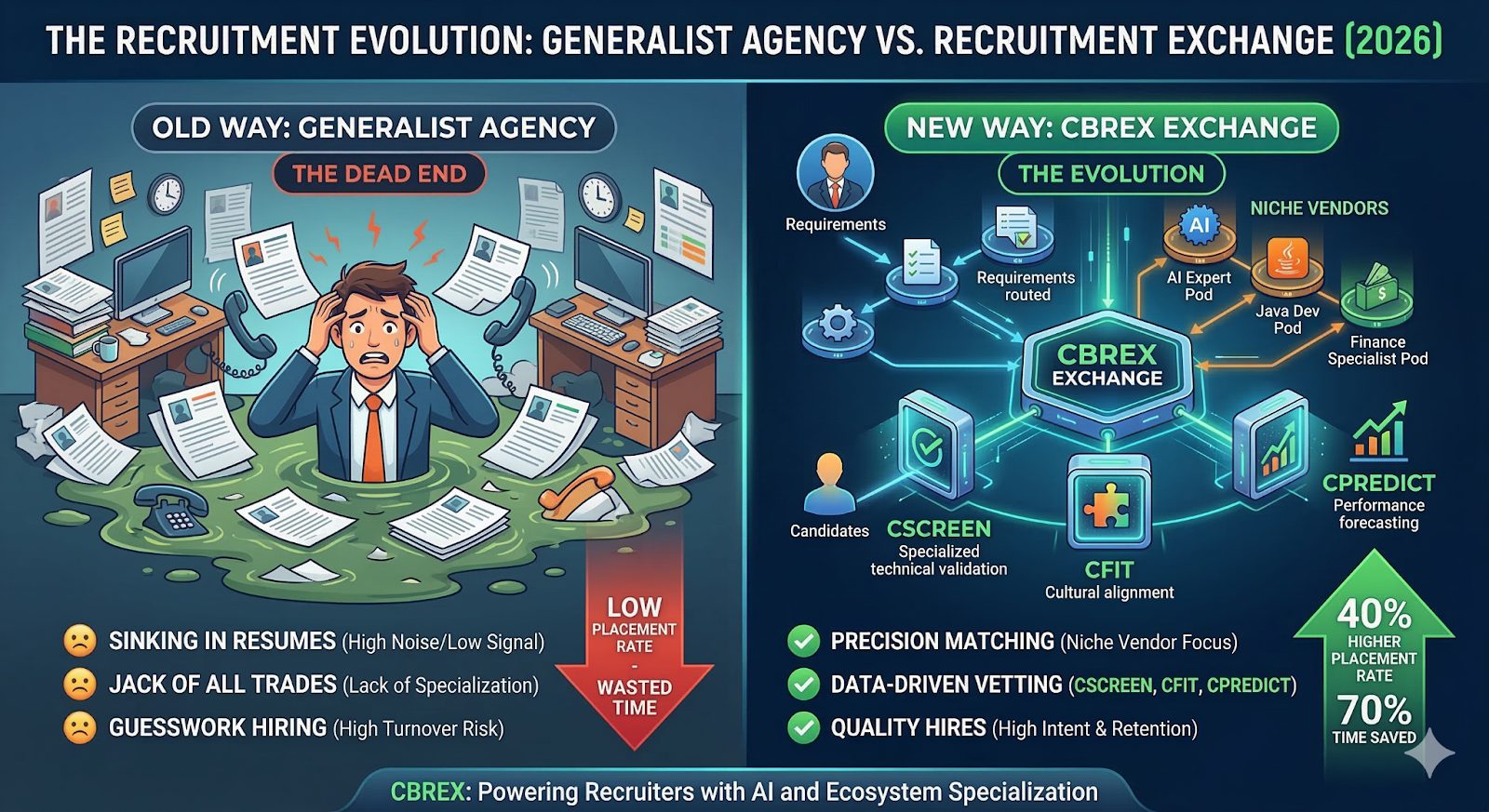
Table of contents

Sign up for regular updates
Get all the news delivered to your inbox.
Thank you! Your submission has been received!
Oops! Something went wrong while submitting the form.

Similar blogs

Read Time :
3 Mins
One Dashboard, 5,000 Agencies: The CFO’s Guide to Recruitment Convenience
In 2026, CFOs are prioritizing efficiency and eliminating operational complexity across the organization. Managing dozens or even hundreds of recruitment vendors creates unnecessary legal, financial, and administrative burdens. The recruitment exchange model offers a smarter alternative by consolidating vendor relationships into a single platform with one Master Service Agreement. This “single-pane-of-glass” approach enables organizations to access thousands of specialized agencies without the overhead of managing multiple contracts, invoices, and systems—transforming recruitment into a streamlined, predictable, and high-output function.
Read Time :
3 Mins
The Accuracy Arbitrage: Why Precision-Vetting is the Only Cure for 2026’s Resume Inflation
In 2026, AI-driven auto-applications have flooded the recruitment funnel, making it harder than ever to identify truly qualified candidates. Resume inflation means that many candidates appear perfect on paper but lack real-world expertise. Precision vetting is emerging as the solution, shifting recruitment from volume-based sourcing to accuracy-driven filtering. By combining technical validation and behavioral analysis, AI-powered recruitment exchanges help organizations cut through noise, verify candidate capabilities, and focus only on high-quality, high-intent talent—transforming hiring into a more efficient and reliable process.Executive Summary: As AI "agents" begin to auto-apply to thousands of roles simultaneously, the traditional recruitment funnel has collapsed under the weight of 5,000+ resumes per job. This post explores the Accuracy Arbitrage—the competitive advantage of using the CBREX exchange to replace "Volume-based" sourcing with High-Precision Filtering. The 2026 Crisis: The "Bot-Flood" and Resume Inflation If you posted a Senior Developer role today, you didn't just invite talent; you invited an army of bots. In 2026, Agentic AI tools can "perfect" a resume and apply to 500 jobs in under 60 seconds. This has led to Resume Inflation—where every candidate looks like a 10/10 on paper, but only 0.1% possess the actual technical depth required. For the modern HR leader, the cost of "Finding" has dropped to zero, but the cost of "Verifying" has skyrocketed. The Senior Insight: In a world of infinite noise, Accuracy is the only premium. The companies that win the talent war in 2026 aren't the ones who see the most resumes; they are the ones who see the right five. How can enterprises use precision-matching to eliminate AI-generated application noise? To beat the "Bot-Flood," you cannot use a bigger bucket (more recruiters); you need a finer mesh (better data). Precision-matching requires a shift from Keyword Recognition to Proven Capability. The CBREX exchange model solves this by utilizing Accuracy & Precision as its core architecture. Instead of a generalist algorithm, the exchange routes requirements to specialized micro-vendors who possess the "Human-in-the-Loop" expertise to spot an AI-hallucinated skill set from a mile away. The Precision Filter: CSCREEN & CPREDICT While job boards offer "matches," CBREX offers "Guaranteed Signal." CSCREEN (The Technical Anchor): This isn't just a quiz. It’s a high-precision validation layer that uses live environment testing to ensure a candidate’s "Rust" or "Cybersecurity" expertise is real. CPREDICT (The Intent Anchor): It analyzes behavioral data to distinguish between a "Bot-Applied" candidate and a "High-Intent" professional. It predicts the likelihood of the candidate actually showing up for the interview. Volume vs. Veracity: The 2026 Benchmarks Data from the CBREX exchange highlights why "Accuracy" is the ultimate ROI lever.
Read Time :
3 mins
How AI-Powered Vendor Matching Reduces 'Time-to-Shortlist' by 40%
In competitive technical hiring markets, speed is critical. The most important recruitment metric today is no longer time-to-fill but time-to-shortlist — the speed at which qualified candidates reach hiring managers. Traditional agencies often rely on manual database searches, which slows down the process and results in outdated candidate matches. AI-powered recruitment exchanges solve this challenge by instantly matching job requirements with specialized vendors who already have access to relevant talent pools. Combined with automated sourcing and technical validation tools, this model dramatically reduces the time needed to produce high-quality candidate shortlists.