Read Time:
What Makes a Good Platform for Global Hiring? 7 Must-Haves


A good platform for global hiring gives you seven things: local specialist coverage, smart role-to-agency matching, one contract and invoice, pay-on-hire pricing, layered screening, speed you can measure, and a fit with your ATS and niche needs. Miss one and the admin comes back through the side door.
We built CBREX around these seven. One contract covers 4,000+ specialist recruiting firms across 55 countries, and you pay only when a hire is made. This guide is for TA leaders at India-founded and mid-market companies hiring outside India. Use it as a scorecard for any platform you shortlist, ours included.
Global hiring programmes stall because every new country brings a new agency, a new contract and a new invoice. The admin multiplies faster than the hires do. TA teams spend their time chasing paperwork and duplicate submissions instead of closing candidates.
The pattern is familiar. You need a sales lead in the US, an engineer in Germany and a finance manager in Singapore. Each market wants a local specialist, so you onboard three vendors, negotiate three sets of terms and reconcile three invoices. Repeat across ten countries and vendor sprawl becomes a job in itself.
We have seen how far this can go. One client consolidated 54 agency contracts into a single CBREX contract. In our AI talent example, 65+ specialist vendors were brought under one agreement. Before consolidation, that client's time-to-hire ran 60-75 days.
After consolidation, the client works with one contract instead of 54, and our typical India-based time-to-hire is 15-45 days. We have no client-specific after-figure beyond that range, so ask any platform for before and after numbers on your own roles.
The fix is not "fewer agencies". Specialists still win on niche roles and local networks. The fix is a platform that keeps the specialists and removes the paperwork. The seven must-haves below show what to look for.
Coverage is the first test. A platform for global hiring should give you vetted, local recruiters in each market where you hire, not one generalist vendor stretched across time zones. Local firms know salary bands, notice periods and where the candidates actually are.
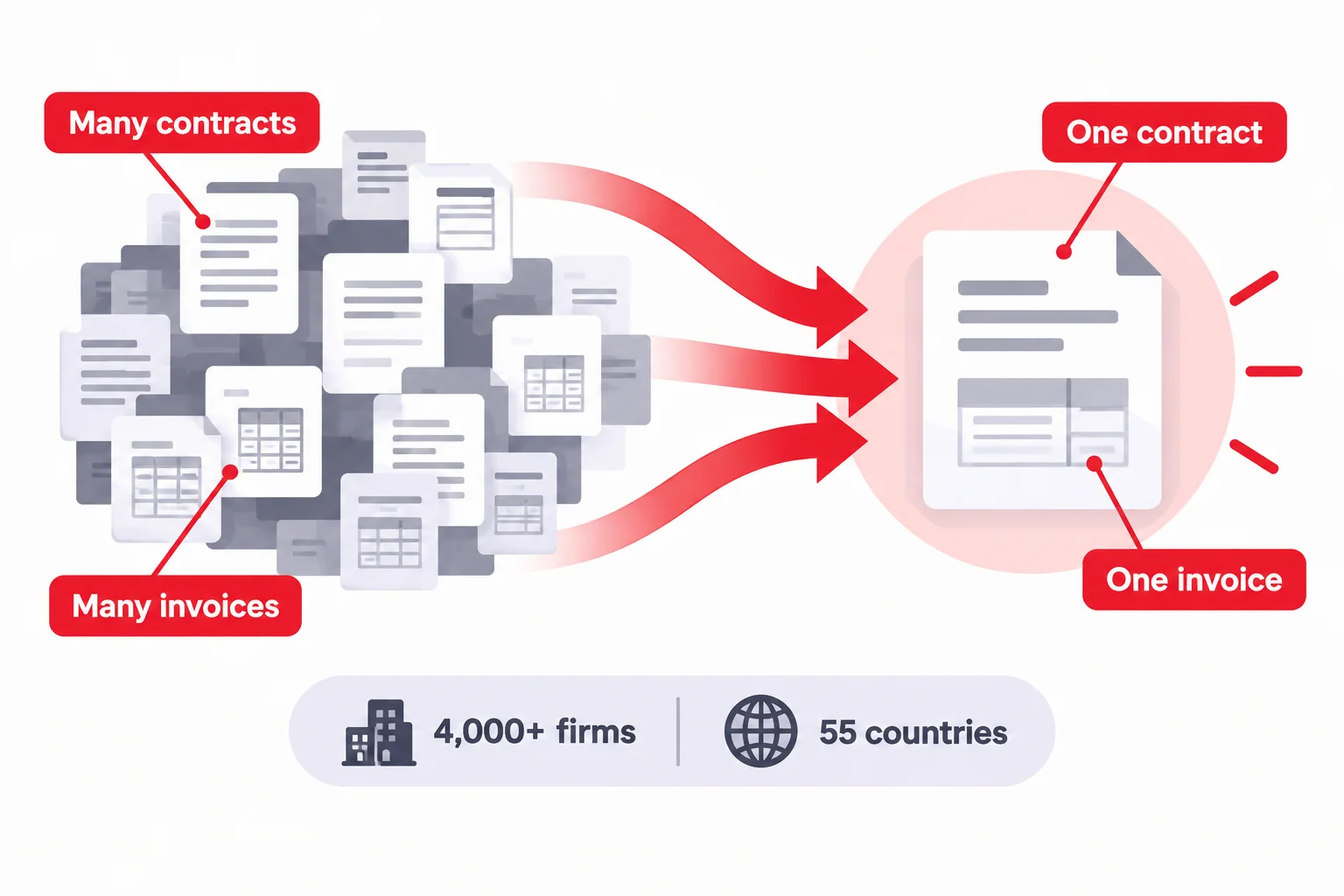
On CBREX, that means vetted local talent across 55 countries from a network of 4,000+ recruiting firms. Those countries include markets Indian companies commonly target, such as the UK, USA, Germany, Singapore, UAE, Japan, Mexico and Vietnam.
A big headline number can hide a dormant network. Ask any platform how many firms in a given country were active in the last month. For reference, 104 US-based recruiting firms are active on CBREX each month, and 32 Mexico-based firms are engaged monthly.
Also check range of skills. A platform that only covers one function limits you. CBREX is function-agnostic, so the same interface can source technology, financial services, manufacturing, pharma and B2B platform roles at any level.
Coverage without matching is noise. If a platform pushes your brief to every agency, you get volume, duplicate profiles and no accountability. You want the role routed to the firms best suited to it.
That is what C Map does on CBREX. It reads the role and routes it to the specialist agencies most likely to fill it, so a niche pharma role reaches pharma specialists and not a general desk. The reader benefit is simple: a smaller, sharper set of recruiters working your role.
Speed follows from this. Our sourcing time is 24-72 hours, and our fastest European shortlist turnaround was 48 hours. Test any platform on the same point: how long from posting a role to the first qualified profiles, and who sets that clock.
For a deeper look at the mechanics, see our guide to multi-geo hiring on one platform.
This is the feature that removes the most work. One agreement should cover every agency on the platform, with one invoice at the end. Our commercial model is exactly that: one contract and one invoice, with no retainers, seat licences or monthly fees.

Compare three setups side by side.
| Feature | Separate agency contracts | Standalone VMS | Single-contract marketplace (CBREX) |
|---|---|---|---|
| Contracts to manage | One per agency | Agency contracts usually still sit underneath | One contract across 4,000+ firms |
| Invoices | One per agency | Depends on set-up | One invoice |
| Adding new suppliers | New onboarding each time | You manage a defined supplier pool | New specialist agencies added on demand |
| Fee model | Agency by agency | Platform fees plus agency fees | No retainers, seat licences or monthly fees; pay on hire |
The on-demand point matters most. A standalone VMS manages the suppliers you already have. On CBREX, we add new agencies to the marketplace on demand, so supply does not dry up when a role needs a specialist you have not used before. If you are searching for an AI vendor management platform or a VMS for direct sourcing, ask whether supply can grow mid-search.
If you want the fuller picture on vendor management systems and how they work in hiring, read our guide to running hiring across five or more countries with one team.
Pricing should track outcomes. A platform for global hiring that charges retainers or seat licences asks you to pay before you know whether it works. On CBREX, there are no upfront fees and you pay only when a hire is made.
Look for three things in the commercial terms.
Clients often calibrate fees on how hard the hire feels. We advise setting them by years of experience instead. A hard-to-find role at a junior level is still a junior placement, and pricing it as senior invites disputes later.
For the cost logic behind this model, our piece on the pay-on-hire recruitment model goes into detail.
AI alone recycles active job seekers and cannot reach passive talent. Human agencies alone vary in quality. The strongest platforms combine both, so hiring managers only see candidates who passed several checks. Indian government coverage of AI recruiting tools points to reduced admin work and faster volume screening as the main gains, which is where screening automation helps most.

CBREX uses 3-level candidate screening:
The result for clients has been an interview-to-offer ratio of 1:3 to 1:4 after 3-level screening, that clients saw after screening. Ask every platform for its equivalent ratio, and ask how it is measured.
When two agencies submit the same candidate, credit disputes eat goodwill. Our duplicate check is built into the platform. At the moment of submission, the second agency learns the candidate is a duplicate and cannot upload the profile. That settles credit before it becomes a dispute.
Read more in our multi-country team guide or, if you prefer a screening-specific view, our post on how 3-level candidate screening works.
Good sales and specialist candidates have a short shelf life, so speed is a commercial issue. Ask any platform for time-to-hire by country, not a single global average. The ranges differ by market, and honest vendors will say so.
These are the timelines we see on CBREX:
| Market | What we see |
|---|---|
| India-based roles | Typical time-to-hire of 15-45 days; our last India GCC or niche search took 24 days from opening to hire |
| Europe | Sourcing in 24-72 hours, then about 3 weeks to hire; fastest shortlist turnaround 48 hours |
| Germany (one search) | 30-45 days with no visa step, as candidates were local or EU citizens |
| US sales and revenue roles | Complete the process within 3 weeks from shortlist to offer |
Notice periods shape these numbers. The typical European notice period is 30 days, so build it into your plan. Where a visa is needed, add that step separately.
Speed also depends on your brief. For US roles, remember the US is not one market: state-wise differences in salary and catchment matter, and fixed versus variable pay is where Indian founders most often slip. Do not benchmark your hiring level against market salaries you are unwilling to match.
A recruitment marketplace finds and screens candidates through specialist agencies. An EOR or payroll platform employs and pays people legally in a country. Pick a marketplace when your problem is finding talent. Pick EOR when you have no entity and need to employ the hire. CBREX has partners that can do EOR in over 90 countries, so you can combine both.
The last must-have is fit. A platform has to plug into how your team already works, and it has to handle roles that do not follow the standard script.
Your recruiters live in an applicant tracking system. CBREX integrates with all ATS platforms, so candidate data flows without re-keying. Ask any platform which systems it integrates with, and what the integration actually syncs.
Some roles, such as replacing a GCC head, cannot be advertised. For confidential search we map only boutique firms whose owners are industry veterans with more than two decades of experience. They know how to be discreet and have the networks to find people quietly. Our leadership hiring works with curated boutique firms and independent search consultants, with no retainer fees. See our leadership hiring, no retainer, pay on hire page for how it runs.
Ask for proof in your niche. We have filled 445 AI or LLM engineer searches, and our roles span the US, Europe, APAC and India, including pharma. A platform that cannot show niche fills is a job board with extra steps.
Score each platform out of seven, one point per must-have, and ask for evidence on each. A platform that scores below five will probably leave you managing agencies yourself. Request written answers on coverage, contract scope, fee triggers, screening stages and country timelines.

Use this checklist in your vendor calls:
One compliance point is specific to Indian employers. Anyone recruiting Indian citizens for employment abroad must register with the Protector General of Emigrants under the Emigration Act, 1983, as the Ministry of External Affairs explains. If you plan to place Indian candidates overseas, check that every agency involved is registered.
If this scorecard matches how you want to hire, book a demo and we will walk you through your own target countries on the platform. You can also see what vendor sprawl is costing you with the Hidden Hiring Tax calculator.
Run a recruiting firm? Corporates post jobs globally on CBREX, and recruiters fill them and earn a commission on every successful hire. Registration is free, so sign up as a recruiting firm. For wider reading on expanding abroad, start with Global Hiring from India: The 2026 Complete Guide.


