Read Time:
Recruitment Agency in Ghana: How to Hire Through Vetted Specialist Agencies (2026)
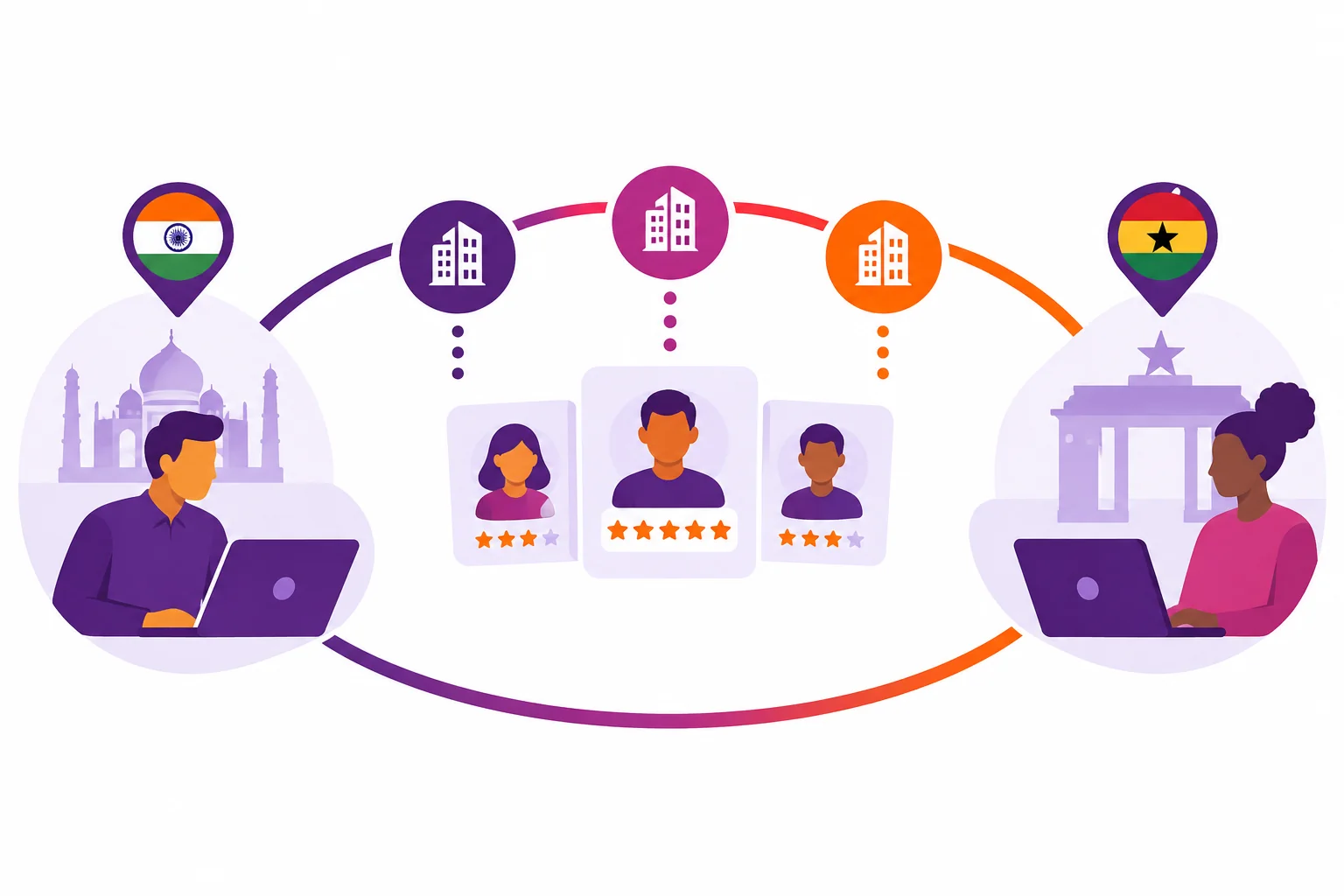

A recruitment agency in Ghana finds, screens and presents candidates for your open role, and the employer pays, normally only when someone is hired. Before you sign, confirm the agency holds a current Ghanaian licence, get the fee trigger and replacement terms in writing, and agree that no candidate pays anything.
At CBREX, we run a marketplace where one contract gives you access to 4,000+ recruiting firms across 55 countries. For a Ghana search, we route your role to vetted specialist agencies, and you pay only when a hire is made. The sections below show you how to do the same checks yourself, whichever route you take.
A Ghana recruitment agency acts as the intermediary between an employer and local candidates. It writes up the role, sources people from its own network and the wider market, screens them, and presents a shortlist. The employer interviews, makes the offer and, when the hire starts, pays the fee.
The value for an India-HQ team is local reach. You may have no Ghanaian entity, no recruiters on the ground and little sense of how pay, notice periods or candidate expectations differ from India. An agency that works the market daily fills that gap.
Some agencies add reference checks or payroll support. Treat those as separate, priced items and ask for them in writing.
A staffing agency is one firm that supplies candidates or temporary workers from its own pool. A recruiting marketplace connects you to many independent agencies through one platform and one agreement. You get wider specialist coverage, and one contract and invoice instead of a separate agreement with every firm.
For a market like Ghana, where one agency may be strong in mining or banking and weak in technology, that spread matters. Our related guide on hiring through a recruitment agency in Kenya shows the same pattern in another African market.
Most agencies charge the employer a percentage of the hire's first-year pay, due once the candidate starts. Others ask for a retainer or a flat fee. The exact rate depends on the country, the seniority of the role and the agency, so get the rate in writing before any search begins.
We do not quote a standard Ghana percentage here, because the fee depends on the location of the hire and the role. What you can control is the structure of the deal. Our guide to recruitment agency fees by country sets out how rates compare across markets.

| Model | When you pay | What to watch |
|---|---|---|
| Contingency (percentage of first-year pay) | When the candidate starts | Define "salary": base only, or base plus bonus and allowances |
| Retained search | Part upfront, balance at milestones | You carry the risk if no hire is made; check what you get back |
| Flat fee | Agreed amount per placement | Confirm it does not rise with salary or seniority |
| Pay-on-hire through a marketplace | Only when a hire is made | Confirm there are no retainers, seat licences or monthly fees |
On CBREX, clients work with one contract and one invoice, with no retainers, seat licences or monthly fees. Our explainer on how pay-on-hire recruitment works covers the mechanics in more detail.
Ask what the fee includes before you compare rates. A lower percentage with no replacement cover can cost more than a higher one that includes it. Check these points:
The employer. The International Organization for Migration's guidance on working with labour recruiters advises that employers pay recruiter fees and costs, preferably directly, so charges are not passed on to workers. Any agency that asks candidates for a fee should be a red flag for you.
One fee mistake we see: clients set fees by how hard the hire feels rather than by the candidate's years of experience. Experience is the cleaner basis, and it is easier to defend with an agency.
Run five checks: licence, written scope and fee terms, candidate ownership, references from comparable searches, and a clear ban on candidate fees. Together they confirm the agency is legal, that you know what you will pay and when, and that you are not exposed to duplicate claims.

Ghana's Labour Act, 2003 (Act 651) regulates private employment agencies. Under section 7, an agency must be a corporate body with a licence from the minister responsible for employment. A Ministry of Labour document hosted by IOM Ghana states that the licence is valid for twelve months and may be renewed.
So ask for the licence certificate and check the renewal date has not passed. Match the legal name on the licence to the name on the contract exactly. A similar name is not enough.
Your contract should name the role, the search area, the fee basis, the fee trigger, the replacement period and the payment terms. If the agency works on several roles for you, each should be listed or covered by clear terms. Vague wording is where fee disputes start.
If two agencies submit the same person, someone must get credit, and the other will argue. Decide the rule before the search starts. On CBREX, the duplication check is built into the platform: when an agency tries to submit a candidate who is already in, it is told at that moment and cannot upload the profile.
Ask the agency for two or three comparable placements in Ghana: same function, similar seniority. Ask how long the roles took to fill and how many hires stayed. A good agency answers specifically, and a weak one answers in general terms.
Many Ghana searches stall because of the employer's brief, not the agency. The most common mistake we see from India-based heads is asking for very high quality talent while not paying at that level. Benchmark against the actual local market, not your home-country salary scale.
If you plan to send Indian staff to Ghana as well, note that India's Ministry of External Affairs says the Emigration Act, 1983 requires anyone recruiting Indian citizens for employment abroad to register with the Protector General of Emigrants. That rule is about recruiting Indians for work abroad, which is different from hiring Ghanaian residents locally.
You post the role once on CBREX. Our AI vendor matching tool, C Map, routes it to the specialist agencies best suited to that function and country. Candidates are screened in three levels, and you work under one contract and one invoice, paying only when a hire is made.

If supply for a role runs thin, we can add specialist agencies to the marketplace on demand. That is something a standalone vendor management system does not offer, because it only manages the suppliers you already have.
Ghana timelines depend on the role and seniority, and we do not publish a Ghana-specific figure. Across CBREX markets generally, the time from role opening to receiving qualified candidates varies between 24 and 72 hours. Treat that as a guide to how the platform works, not a promise for a Ghana search.
Ask any agency, including those on our network, to commit to a date for the first shortlist in writing. The same applies to hiring managers: slow feedback adds more delay than sourcing does.
A single Ghana agency may be the right call for one role. But if you also hire in Kenya, South Africa or the UAE, separate contracts multiply fast. In one case, a client consolidated 54 agency contracts into one CBREX contract, and its time-to-hire fell from 60-75 days before consolidation. Our guide to international recruitment across 55 countries explains how that works.
If you are weighing how much hidden admin your agency setup costs, you can calculate your Hidden Hiring Tax. To see how a Ghana role would be routed and screened, book a CBREX demo and bring your open role.
Based in Ghana and run a recruitment, staffing or executive search firm, or work as a self-employed recruiter? Sign up as a recruiting firm. Registration is free, we charge sourcing partners no fees or subscription, and you get a Quickstart Guide and a dedicated Technical Support team.


