Read Time:
18 Mins
Niche Recruitment: 15 Most-Asked Questions Answered


Here's a question that lands in the inbox of almost every TA leader at a growing Indian company: "We've briefed three agencies on this role. It's been six weeks. Why don't we have a shortlist yet?" The answer, almost always, is the same. The role is niche. And the hiring process wasn't built for it.
Niche recruitment is one of the most misunderstood areas of talent acquisition — especially for India-founded companies scaling globally. The tools, timelines, and agency types that work for volume hiring simply don't apply when you're looking for a regulatory affairs specialist in Germany, a semiconductor process engineer in Malaysia, or a clinical data manager in the United States. This guide answers the 15 questions companies ask most often about niche recruitment, from the basics to the global and the technical.
Before diving into the questions, it helps to define the term clearly. Niche recruitment refers to the process of hiring for roles that require rare, highly specific skills, domain expertise, or a combination of both. These are not roles you can fill by posting on a job board and waiting. They require active sourcing, specialist knowledge, and access to passive talent pools that most generalist agencies simply don't have.
For mid-market Indian companies going global — whether you're a pharma company hiring in the EU, a GCC building a team in Singapore, or a manufacturing firm expanding into Eastern Europe, niche recruitment is not an edge case. It is the norm. And the gap between what traditional hiring channels deliver and what these roles actually demand is where most hiring delays, cost overruns, and missed business targets originate.
A role is niche when the qualified candidate pool is small, the skills are highly specialised, or the combination of requirements is uncommon. Examples include: a GMP-certified quality assurance manager with experience in biologics manufacturing, a FPGA design engineer with automotive-grade certification, or a transfer pricing specialist with Southeast Asia regulatory experience. What makes these roles niche isn't just technical depth, it's the intersection of multiple specific requirements that dramatically shrinks the available talent pool.
In the Indian context, niche recruitment also includes roles that are geographically niche: hiring a Mandarin-speaking compliance officer in Hong Kong, or a Dutch-speaking customer success manager in the Netherlands. The skill may not be rare globally, but the combination of language, location, and domain expertise makes the search highly specialised.
Three reasons drive most of the delay. First, the candidate pool is genuinely small. There may be only a few hundred qualified people in the world for a given niche role, and most of them are already employed. Second, passive candidates, those not actively looking, make up the majority of the qualified pool. Reaching them requires specialist recruiters with existing relationships, not job board postings. Third, most companies brief generalist agencies who lack the domain knowledge to identify, qualify, and engage the right candidates. The result is a flood of irrelevant CVs and a shortlist that never materialises.
According to research from SHRM's talent acquisition resources, hard-to-fill roles can take two to four times longer to close than standard positions, and that gap widens significantly when the hiring company is operating across geographies it doesn't have established recruiter networks in.
The visible cost is the agency fee. The invisible cost is far larger. A vacant niche role typically means a delayed product launch, a compliance gap, a revenue target missed, or a project stalled. For a senior specialist role with a salary of ₹40, 60 lakhs per annum, a 90-day vacancy can represent ₹10, 15 lakhs in lost productivity, before you count the hiring manager's time, the cost of interim workarounds, and the compounding effect on team morale.
For a deeper breakdown of what unfilled roles actually cost, see our guide on the hidden cost of roles left open. The numbers are consistently higher than most TA leaders expect when they account for all the variables.

Job boards are built for active job seekers. They work well when the candidate you need is already looking, already registered, and already willing to respond to a job alert. For niche roles, that describes a small minority of the qualified pool. The best semiconductor engineer in Bengaluru is not refreshing Naukri. The most experienced regulatory affairs director in Germany is not responding to a LinkedIn Easy Apply. They are doing their jobs, and they will only move for the right opportunity, presented by the right person, at the right time.
Job boards also suffer from a signal-to-noise problem. Post a niche role on a major job board and you will receive applications, but most will be from candidates who meet one or two of your criteria, not all of them. Your hiring manager spends hours screening irrelevant CVs instead of interviewing qualified candidates. That's not a sourcing strategy. That's a time tax.
Occasionally, yes. Consistently, no. A generalist agency has broad reach but shallow domain expertise. They can fill a sales executive role or a finance manager position efficiently. But when you need a clinical pharmacokineticist or a VLSI verification engineer, a generalist recruiter doesn't know the right questions to ask, the right communities to tap, or the right signals to look for in a CV. They will search their existing database, post on the same job boards, and deliver the same pool of active candidates that you could have found yourself.
The deeper problem is that generalist agencies often don't know what they don't know. They'll accept the brief, promise a shortlist in two weeks, and then go quiet, because the role is outside their actual capability. For guidance on how to evaluate any agency before you brief them, our post on how to choose a recruitment agency covers the criteria and red flags in detail.
A specialist recruiter operates within a defined domain, pharma, semiconductor, fintech, supply chain, or a specific geography. They have built relationships with passive candidates over years. They know who the top performers are, which companies they're at, and what it would take to move them. They speak the language of the role: they can assess a CV accurately, ask the right technical questions in a screening call, and represent the opportunity credibly to a candidate who has no reason to take a cold call from someone they don't trust.
The difference in output is significant. A specialist recruiter typically delivers a shortlist of three to five genuinely qualified candidates. A generalist recruiter delivers a stack of CVs that requires your hiring manager to do the specialist's job for them. For niche recruitment, the quality of the recruiter is the single biggest variable in whether the role gets filled, and how quickly.
Honest answer: it depends on the depth of the niche, the geography, and the quality of the recruiter you're working with. For most specialist roles in India, a well-briefed specialist agency can deliver a qualified shortlist within two to three weeks. For global niche roles, particularly in markets like Germany, Japan, or the United States, expect four to six weeks for a shortlist, and eight to twelve weeks from brief to offer acceptance, accounting for notice periods.
The biggest variable is not the candidate market. It's the recruiter's access to it. A specialist agency with an established network in your target geography can compress timelines significantly. A generalist agency with no local relationships will stretch them. This is why the choice of recruiter matters more for niche recruitment than for any other type of hiring.
Specialist agency fees for niche roles typically range from 15% to 25% of the candidate's first-year salary, depending on the seniority of the role, the geography, and the scarcity of the skill. Leadership-level niche roles can attract fees at the higher end of this range. Some boutique search firms charge retainers on top of placement fees.
The more important question is cost-per-hire in context. A 20% fee on a ₹50 lakh salary is ₹10 lakhs. If that hire closes a compliance gap that was costing ₹5 lakhs per month in operational risk, the fee pays for itself in two months. For a full breakdown of what recruitment actually costs when you account for all variables, see our analysis of cost per hire in 2026.
Retainers are the traditional model for executive search and highly specialised niche roles. The logic is that the recruiter invests significant time in a dedicated search, and the retainer compensates them for that effort regardless of outcome. The problem is that retainers transfer financial risk to the employer. You pay upfront, and if the search fails or the candidate doesn't work out, you've spent money with nothing to show for it.
The alternative, a contingency or pay-on-hire model, aligns incentives better. You only pay when a hire is made. For most niche roles below the C-suite, a well-structured contingency arrangement with a specialist agency delivers the same quality of search without the upfront financial commitment. Platforms like CBREX operate entirely on a pay-on-hire basis, even for specialist and leadership roles, which removes the retainer risk entirely.
Yes, but only when AI is used to augment specialist human recruiters, not replace them. AI tools are excellent at processing large volumes of data: screening CVs at scale, identifying pattern matches across candidate profiles, and ranking candidates against defined criteria. Where AI alone falls short in niche recruitment is in the human judgment required to assess cultural fit, engage a passive candidate, and navigate the nuanced conversation that moves a top performer from "not looking" to "open to a conversation."
The most effective niche recruitment approaches in 2026 combine AI-powered screening and matching with specialist human recruiters who have domain expertise and candidate relationships. AI handles the volume and quality control. Humans handle the relationship and the close. That combination is what separates a genuine AI-powered recruitment marketplace from a glorified job board with an algorithm bolted on.
AI resume screening uses machine learning to evaluate CVs against role requirements, ranking candidates by fit and flagging those that meet the criteria. For niche roles, the quality of the AI model matters enormously. A generic screening tool trained on broad datasets will struggle to differentiate between a regulatory affairs specialist with EU experience and one with only domestic Indian experience, a distinction that is critical for a European market hire.
CBREX's C Screen tool is trained on over 250,000 anonymised resumes across 570+ job categories, giving it the domain-specific depth to screen niche candidates accurately. It achieves 98% screening accuracy and operates as a second validation layer after the specialist agency has pre-screened candidates, so by the time a CV reaches your hiring manager, it has passed two rounds of quality control. For a full guide to evaluating AI screening tools, see our post on how to choose the right AI resume screening tool.
A traditional job board is a passive channel. You post a role, candidates apply, and you screen what arrives. The quality of your shortlist is entirely dependent on who happens to be actively looking and who happens to find your posting. For niche roles, this model produces poor results because the best candidates aren't looking.
An AI-powered recruitment marketplace is an active channel. It routes your role to specialist agencies with proven track records in your specific domain and geography. Those agencies actively source passive candidates from their networks. AI then validates the quality of what comes back before it reaches you. The result is a curated shortlist of pre-screened, genuinely qualified candidates, not a pile of applications to sort through. The difference in time-to-shortlist and candidate quality is significant, particularly for niche recruitment where the margin for error is low.
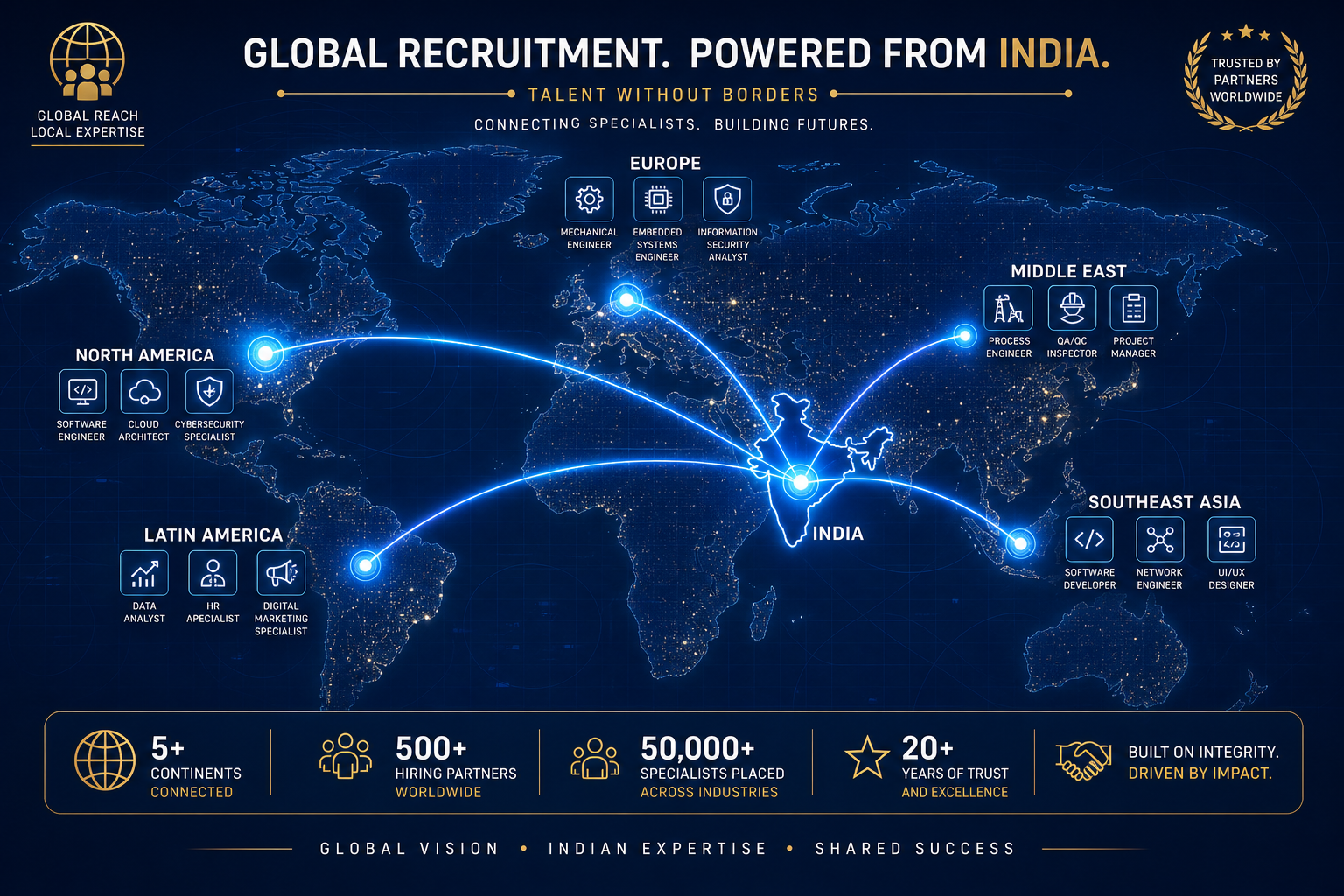
This is one of the most common challenges facing India-founded companies in 2026. You need a supply chain director in Germany, a clinical operations manager in the United States, or a fintech compliance lead in Singapore. Your existing Indian agency network has no reach in those markets. Your job board subscriptions don't cover those geographies. And hiring a local agency in each country means a new contract, a new relationship to manage, and a new invoicing process to set up.
The most effective approach is to work with a platform that has pre-vetted specialist agencies across your target geographies under a single contract. CBREX operates across 33 countries, including Germany, the USA, Singapore, the UAE, Japan, Australia, and across LATAM and Eastern Europe, with 4,000+ specialist recruiting firms accessible through one agreement. You brief the role once. The platform routes it to the right agencies in the right market. You receive pre-screened candidates. You pay only when you hire.
For a comprehensive guide to cross-border hiring strategy, see our post on global hiring from India in 2026.
Vendor sprawl is the inevitable result of solving niche recruitment the traditional way. You hire a specialist agency for your pharma roles in Germany. Another for your tech roles in Singapore. Another for your finance roles in the UAE. Before long, you have 15 agency relationships, 15 contracts, 15 invoicing processes, and no visibility across any of them. Your TA team spends more time managing vendors than managing hiring.
The solution is vendor consolidation through a managed marketplace model. Instead of managing individual agency relationships, you work through a single platform that manages the agencies on your behalf. You get access to specialist expertise across every domain and geography you need, without the administrative overhead of managing each relationship directly. For a detailed look at how vendor consolidation works in practice, see our guide on vendor consolidation in recruitment.
A recruitment marketplace is a platform that connects employers with a curated network of specialist recruiting firms, using AI to match roles to the most relevant agencies and validate candidate quality before it reaches the hiring manager. Unlike a staffing agency (which has its own recruiters) or a job board (which aggregates active candidates), a recruitment marketplace gives you access to hundreds of specialist agencies simultaneously, each with their own passive candidate networks in their specific domain.
For niche recruitment at scale, this model solves three problems at once. First, it gives you access to specialist expertise across every domain and geography you need. Second, it eliminates the vendor management overhead of running multiple agency relationships. Third, it applies AI-driven quality control so that only genuinely qualified candidates reach your hiring managers. The result is faster time-to-hire, lower cost-per-hire, and a shortlist quality that generalist channels simply cannot match.
To understand how this model compares to RPO and traditional staffing, see our breakdown of RPO vs staffing in India and which model wins for different hiring scenarios.
CBREX was built specifically for the niche recruitment challenge that India-founded companies face as they scale globally. The platform connects employers with 4,000+ specialist recruiting firms across 33 countries through a single contract and unified invoicing. There are no retainers, no seat licences, and no upfront fees. You pay only when a hire is made.
Here's how the platform addresses niche recruitment at each stage of the process:
The platform has successfully placed niche talent across pharma, technology, manufacturing, financial services, and healthcare, in markets including North America, LATAM, MENA, SEA, EMEA, Eastern Europe, Japan, and Oceania. For mid-market Indian companies that need specialist talent in markets where they have no existing recruiter relationships, CBREX provides immediate access to the specialist networks that would otherwise take years to build.
If you're evaluating whether a recruitment marketplace model fits your hiring structure, our guide on hiring platforms in India compares job boards, agencies, and AI marketplaces across the criteria that matter most for niche and specialist roles.
"Your best hire isn't looking. AI finds them. Humans close them.", CBREX's approach to niche recruitment combines the reach of specialist human networks with the precision of AI-driven quality control.
Fifteen questions, one consistent theme: niche recruitment requires a fundamentally different approach from standard hiring. Job boards reach active candidates. Niche roles require passive ones. Generalist agencies have broad reach but shallow domain expertise. Niche roles require specialist recruiters with established networks. Retainer models transfer risk to the employer. Pay-on-hire models align incentives correctly. Managing multiple specialist agencies creates vendor sprawl. A recruitment marketplace consolidates access without sacrificing specialist depth.
Here are the principles that separate companies that fill niche roles efficiently from those that struggle for months:
If your organisation is facing niche recruitment challenges, whether you're hiring a single specialist role or building a global team across multiple markets, CBREX gives you access to the specialist recruiter networks, AI-powered quality control, and single-contract simplicity that the traditional model can't match. Book a demo to see how CBREX routes your niche roles to the right specialist agencies globally, with no retainers and no upfront fees. Or, if you'd prefer to start immediately, sign up on the platform and post your first niche role today. You can also reach out directly if you'd like to discuss your specific niche hiring challenges before committing to anything.
Niche recruitment doesn't have to mean months of waiting and stacks of irrelevant CVs. With the right specialist network and the right AI-powered platform behind it, even the hardest-to-fill roles become solvable, faster, and at a cost that makes sense.


