Read Time:
18 Mins
Three-Level Candidate Screening: Build Interview-Ready Shortlists


Ask any hiring manager at an Indian mid-market company what their biggest frustration is, and the answer rarely involves finding candidates. It involves reviewing them. Specifically, reviewing 30 CVs to find three worth calling. That ratio — roughly 10 to 1 — is the quiet tax that broken screening pipelines impose on every hiring cycle. The three-level candidate screening process exists to fix that ratio before it reaches the hiring manager's desk.
This guide walks through each of the three gates in detail: what happens at each stage, what gets filtered out, and why removing any single layer collapses the quality of the shortlist. If your TA team is managing multi-geography hiring — across APAC, EMEA, MENA, or LATAM, the stakes are even higher. A poor shortlist in a market you don't know well costs far more than time.
The failure mode is predictable. A role opens. The TA team briefs two or three agencies. CVs arrive over the next week, sometimes dozens of them. The hiring manager, who has a day job beyond reviewing applications, opens the folder and starts reading. By the fifteenth CV, attention is fading. By the twenty-fifth, frustration has set in. The shortlist that eventually gets scheduled for interviews is shaped as much by fatigue as by fit.
This is not a people problem. It is a process problem. Most recruitment pipelines rely on a single layer of screening, usually the agency's own judgment, with no standardised validation on top. The result is inconsistent quality, because different agencies apply different standards, and no two recruiters evaluate the same criteria the same way.
For Indian companies hiring domestically, this is an inconvenience. For companies hiring across multiple geographies simultaneously, say, a Bengaluru-headquartered firm filling roles in Singapore, Germany, and the UAE in the same quarter, it becomes a serious operational risk. Hiring managers in those markets have even less context to evaluate CVs quickly, and the cost of a wrong shortlist is compounded by time zone delays and local compliance complexity.
The solution is not more agencies. It is a structured, multi-layer screening process where each gate does a specific job, and the output of one feeds the input of the next. That is precisely what the three-level candidate screening process delivers.
"The problem isn't too few candidates. It's too many unqualified ones reaching the wrong people at the wrong stage."
For a broader look at how screening fits into the wider talent acquisition picture in India, the Talent Acquisition in India 2026: The Complete Local Guide covers the full landscape, from sourcing models to evaluation frameworks.
The three-level candidate screening process is a sequential filtering system with three distinct gates. Each gate has a specific purpose, a specific set of inputs, and a specific output. Candidates must pass all three to reach the hiring manager's shortlist.
The critical design principle is that these layers are sequential, not parallel. Level Two only sees candidates that passed Level One. Level Three only ranks candidates that passed Level Two. This compounding filter is what produces a shortlist where the top five candidates are genuinely the top five, not just the five who happened to arrive first.
The first gate is human. Specialist recruiting agencies, not generalist job boards, not internal sourcers working from a database of active applicants, conduct the initial sourcing and pre-screening. This distinction matters more than most TA leaders realise.
A specialist agency working in, say, regulatory affairs for the pharmaceutical sector in Germany has a network of passive candidates that no job board can replicate. These are professionals who are not actively looking, who will not respond to a LinkedIn InMail from an unknown recruiter, but who will take a call from someone they know and trust in their niche. That access is the core value of Level One.
At this stage, the agency applies its own pre-qualification criteria: Does the candidate's experience match the seniority level? Have they worked in the relevant industry vertical? Are they genuinely available, or just casually open to conversations? Is their compensation expectation within the approved band? These are questions that require a human conversation, not a keyword match.
What gets filtered at Level One is significant. Candidates who look good on paper but are not actually available. Candidates whose titles suggest seniority but whose responsibilities do not. Candidates who are a strong fit for a different role but not this one. A well-briefed specialist agency removes all of these before a single CV is submitted.
The challenge for most TA teams is knowing which agencies to brief for a given role in a given market. A Bengaluru-based TA head hiring a cloud security architect in Singapore and a QA lead in Poland simultaneously cannot be expected to maintain deep relationships with specialist agencies in both markets.
CBREX's C Map AI solves this. When a role is posted on the platform, C Map analyses the job requirements and routes the brief to the most relevant specialist agencies from a network of 4,000+ recruiting firms across 33 countries. The TA team does not need to know which agency is best for semiconductor hiring in South Korea or regulatory talent in Germany. C Map does that matching automatically, ensuring that Level One is staffed by the right specialists for every role, in every market.
This is particularly valuable for Indian mid-market companies expanding globally. Rather than building agency relationships market by market, a process that takes years and significant budget, they get immediate access to a curated specialist network through a single platform and a single contract.
For more on how passive talent sourcing works at this stage, see Passive Talent Sourcing Strategy: Fix What's Failing.
Once specialist agencies have submitted their pre-qualified candidates, the second gate activates. This is where AI takes over from human judgment, not to replace it, but to standardise and validate what human judgment has already produced.

CBREX's C Screen is an AI resume screening engine trained on more than 250,000 anonymised resumes across 570+ job categories. When an agency submits a candidate, C Screen evaluates the CV against the specific role requirements, not generic criteria, but the actual brief that was posted on the platform.
The evaluation covers multiple dimensions: skills alignment, experience depth, tenure patterns, seniority consistency, and role-specific requirements. C Screen also flags profiles where the CV appears to have been optimised for keyword matching rather than genuine fit, a growing problem as candidates use AI tools to tailor applications.
Human reviewers are excellent at evaluating individual CVs. They are less reliable when reviewing 40 CVs across three different markets in a single afternoon. Attention degrades. Criteria drift. The fifteenth CV gets less scrutiny than the first.
AI does not have this problem. C Screen applies the same evaluation criteria to every CV, regardless of submission order, formatting style, or the reputation of the submitting agency. This consistency is what makes Level Two valuable, it removes the variance that human review introduces at scale.
Specific patterns that C Screen catches include: inflated job titles that do not match the described responsibilities; tenure gaps that suggest the candidate is less experienced than their headline suggests; skills listed without evidence of application; and seniority mismatches where a candidate is either overqualified or underqualified for the role band.
C Screen operates at 98% accuracy across its training dataset. For a detailed breakdown of what that figure means in practice, and how to evaluate AI screening accuracy claims from any vendor, see AI Resume Screening: How to Choose the Right Tool in 2026.
A secondary benefit of AI validation at Level Two is bias reduction. Human reviewers, even experienced ones, are influenced by factors that should not affect hiring decisions: the prestige of a candidate's previous employer, the formatting quality of their CV, or the confidence of the submitting agency's pitch. C Screen evaluates the substance of the profile, not its presentation. This produces a more consistent and defensible shortlist.
The candidates who pass Level Two are not yet a shortlist. They are a validated pool. Level Three converts that pool into an ordered, interview-ready shortlist by ranking every surviving candidate against each other.
Stack ranking assigns each candidate a composite fit score based on multiple weighted criteria: skills match against the role requirements, depth of relevant experience, seniority alignment, location and availability, and any role-specific factors specified in the brief. Candidates are then ordered from highest to lowest fit score.
The output the hiring manager receives is not a folder of CVs. It is a ranked list where Candidate 1 is the strongest fit, Candidate 2 is the second strongest, and so on. The hiring manager can start at the top and work down, confident that the ordering reflects genuine fit rather than submission timing or agency relationship strength.
Most agencies produce shortlists. Fewer produce interview-ready shortlists. The distinction is important. A shortlist is a filtered set of candidates. An interview-ready shortlist is a ranked, validated set of candidates where the hiring manager can schedule the top three and be confident they are genuinely the top three available in the market at that moment.
This confidence is what Level Three delivers. Without stack ranking, even a well-screened pool of candidates requires the hiring manager to do their own comparative evaluation, which is exactly the work the three-level process is designed to eliminate.
The downstream impact of Level Three is significant. When hiring managers receive a ranked shortlist of five candidates rather than a pile of twenty CVs, their review time drops dramatically. More importantly, their confidence in the process increases. They stop second-guessing whether they missed a strong candidate buried in the pile, because the ranking has already done that comparative work.
This confidence compounds over time. Hiring managers who trust the screening process engage more actively with it, providing faster feedback, clearer briefs, and more decisive interview decisions. The entire hiring cycle accelerates. For a detailed look at what slow hiring actually costs, see Time to Hire: The Hidden Cost of Roles Left Open.

Each level of the three-level candidate screening process is valuable on its own. Together, they are transformative. Remove any single layer and the system degrades in a predictable way.
AI-only screening platforms, those that pull from active job seeker databases and apply algorithms without human sourcing, skip Level One entirely. The result is a pool of candidates who are all actively looking for work. That sounds fine until you consider that the best candidates for most specialist roles are not actively looking. They are employed, performing well, and not refreshing job boards. AI-only platforms cannot reach them. The shortlist they produce is drawn from a fundamentally limited pool.
Agency-only screening, where the agency submits CVs and the hiring manager reviews them directly, skips Level Two. The result is inconsistent quality across agencies and across markets. Some agencies apply rigorous pre-screening. Others submit anyone who is broadly available. Without AI validation, there is no standardised check on what agencies submit. AI-optimised CVs, profiles that have been keyword-stuffed to pass basic screening, slip through. The hiring manager ends up doing the validation work that Level Two should have done.
Even with strong agency pre-qualification and AI validation, skipping stack ranking leaves the hiring manager with a validated pool rather than a ranked shortlist. They still have to do comparative evaluation. They still have to decide which of the ten validated candidates are the top three. Level Three removes that burden. Without it, the process is better than most, but not as good as it should be.
The three levels compound each other's value. Level One produces a higher-quality input for Level Two, which means AI validation is working with better raw material. Level Two produces a cleaner, more consistent pool for Level Three, which means stack ranking is comparing genuinely qualified candidates rather than filtering out obvious mismatches. The output of the full three-level process is qualitatively different from what any single layer, or any two layers, can produce alone.
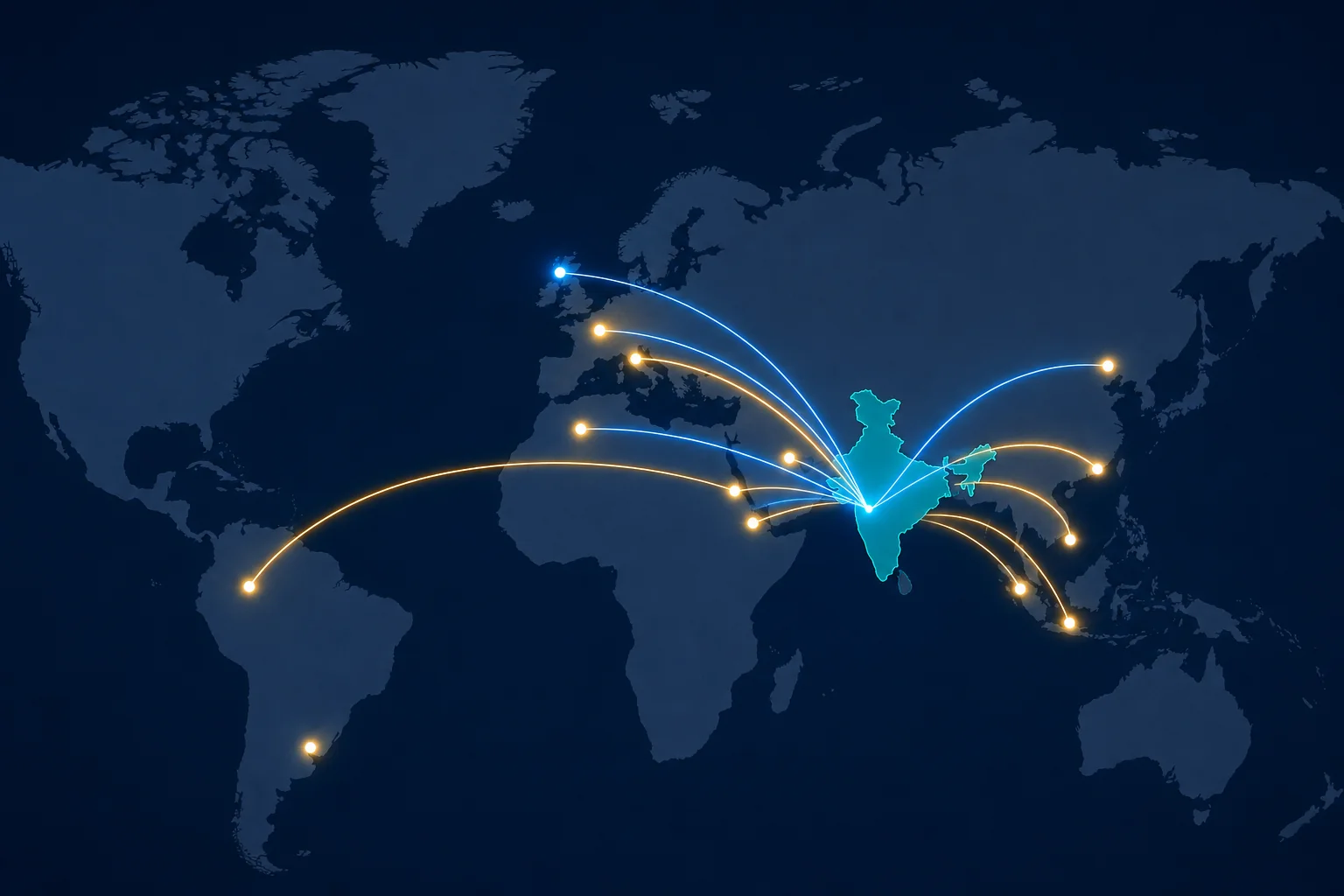
The three-level candidate screening process is valuable for any hiring context. It is particularly powerful for Indian mid-market companies hiring across multiple geographies simultaneously, a challenge that is becoming the norm rather than the exception as Indian enterprises expand globally.
Consider a TA head at a Pune-based technology company managing open roles in Singapore, Germany, and the UAE in the same quarter. Each market has different talent pools, different agency ecosystems, different seniority conventions, and different compensation benchmarks. Applying a consistent screening standard across all three is nearly impossible with a traditional agency panel model.
The three-level process solves this by standardising the evaluation criteria at Level Two and Level Three, while allowing Level One to be market-specific. The specialist agencies briefed for Singapore are different from those briefed for Germany, C Map ensures the right agencies are engaged in each market, but the AI validation and stack ranking criteria are consistent across all markets. The hiring manager receives shortlists from three different geographies that are directly comparable, because they have been evaluated against the same standards.
One of the most significant operational benefits of the CBREX platform is that the three-level process scales across 33 countries without adding vendor complexity. The TA team does not need separate contracts with agencies in each market, separate invoicing cycles, or separate relationship management overhead. A single contract covers the entire specialist agency network. A single platform manages the three-level screening process across all active roles, in all markets, simultaneously.
This is a meaningful advantage for Indian companies that are growing their international footprint. The administrative overhead of multi-geography hiring, managing 15 or 20 agency relationships across different markets, each with different fee structures and invoicing terms, is one of the primary reasons TA teams resist expanding their hiring geography. The single-contract model removes that friction.
For a comprehensive look at how Indian companies are building global teams, see Global Hiring from India: The 2026 Complete Guide. For niche roles specifically, Hiring Niche Skills Overseas: A TA Playbook covers the sourcing strategy in detail.
The three-level process is effective across all role types, but it delivers disproportionate value for specific categories:
For leadership roles specifically, the combination of specialist boutique agency access at Level One and AI validation at Level Two is particularly powerful. See Leadership Hiring India: The 2026 Complete Guide for how this applies to C-suite and senior management searches.
The three-level process is typically faster than traditional agency-only screening, despite having more stages. The reason is that each stage is optimised for speed: C Map routes roles to agencies immediately, C Screen validates CVs as they are submitted rather than in batches, and stack ranking is generated automatically. The hiring manager receives a ranked shortlist rather than a growing pile of CVs to review manually. Total time-to-shortlist is reduced, and time-to-hire follows.
Yes. CBREX integrates with all major applicant tracking systems. The three-level screening process operates within the platform, and the output, ranked, validated candidate profiles, can be pushed directly into your ATS workflow. There is no need to manage a separate system or duplicate data entry. Your existing hiring manager review process remains intact; it simply receives better inputs.
All roles benefit from structured screening, but the return is highest for niche, senior, and cross-border roles where the cost of a poor shortlist is greatest. Roles that are hard to fill using job boards, because the best candidates are passive, benefit most from Level One's specialist agency sourcing. Roles where CV quality is inconsistent benefit most from Level Two's AI validation. Roles where the hiring manager is time-constrained benefit most from Level Three's stack ranking.
Recruitment Process Outsourcing (RPO) typically involves outsourcing the entire recruitment function to a third party. The three-level candidate screening process is a specific methodology within a broader talent acquisition strategy, it can operate within an RPO model, alongside an internal TA team, or as a standalone service. CBREX's AI-powered RPO offering uses the three-level process as its core screening methodology, but the process itself is applicable regardless of the broader hiring model. For a detailed comparison, see RPO vs Agency India: Which Model Wins for Mid-Market Companies.
The hiring manager receives a ranked shortlist of pre-screened, AI-validated candidates ordered by fit score. Each profile includes the candidate's CV, the agency's pre-qualification notes, the C Screen validation summary, and their stack ranking position. The hiring manager can review the top three candidates and schedule interviews immediately, confident that the ranking reflects genuine fit rather than submission order or agency preference.
CBREX operates on a pay-on-hire model, no retainers, no seat licences, no upfront fees. You pay when a hire is made. The three-level screening process is built into the platform, not charged as an add-on. For a detailed breakdown of how recruitment costs compare across models, see Recruitment Agency Cost in India: What You're Really Paying.
The three-level candidate screening process is not a theoretical improvement. It is a structural fix for a problem that costs Indian TA teams thousands of hours and dozens of delayed hires every year. By combining specialist agency pre-qualification, AI validation, and stack ranking into a sequential filtering system, it converts a chaotic pile of CVs into a ranked, interview-ready shortlist, every time, for every role, in every market.
For Indian mid-market companies hiring across multiple geographies, the value compounds further. The same three-level process that works for a Bengaluru tech hire works equally well for a Singapore cloud architect, a German regulatory specialist, or a UAE sales leader, with consistent evaluation criteria, a single contract, and no additional vendor management overhead.
If your hiring managers are still reviewing 30 CVs to find three worth calling, the three-level candidate screening process is the fix your pipeline needs. Book a demo with CBREX to see exactly how the three levels work in practice, and what a genuinely interview-ready shortlist looks like for your open roles. Or, if you'd prefer to start a conversation first, reach out directly and a member of the team will walk you through the process for your specific hiring context.
Ready to see the platform in action? Sign up on CBREX and post your first role today, no retainer, no upfront commitment, just better shortlists.


