Read Time:
3 Mins

Struggling with AI-generated job applications? Learn how precision vetting reduces resume noise and improves hiring accuracy in 2026.

By
CBREX

Executive Summary: In the high-velocity tech corridors of 2026, "Ghosting" has evolved from an annoyance into a systemic financial risk. As candidates in hubs like Bengaluru and Riyadh hold record-high offer counts, "Hope" is no longer a viable recruitment strategy. This post explores how the CBREX Guaranteed Delivery model uses behavioral data to close the "Certainty Gap" and ensure 100% interview integrity.

The 2026 Crisis: The "Offer-Hoarding" Economy

In the current landscape, a Senior DevOps Engineer or AI Architect doesn't just look for a job; they manage a portfolio of offers. "Ghosting"—the act of skipping interviews or failing to show up on Day 1—is often a byproduct of Offer-Hoarding. For the hiring manager, the cost is staggering. When a candidate ghosts a final round, it’s not just the recruiter's time that is wasted; it is 5–10 hours of senior technical leadership’s time. In 2026, this "Reliability Debt" is the #1 silent killer of high-growth tech hubs.

The Senior Insight: Ghosting is rarely a personality trait; it is a Data Failure. If a candidate doesn't show up, your sourcing funnel failed to flag the "Lack of Intent" signals early enough.

How to ensure 100% interview attendance and delivery in competitive tech markets?

The only way to guarantee delivery in a saturated market is to replace "Subjective Promises" with "Predictive Reliability." This requires a move away from generalist agencies who are spread too thin and a shift toward an exchange model that incentivizes Certainty.

The CBREX model solves for this by treating Certainty as a technical SLA (Service Level Agreement), not a "Best-Effort" goal.

The 3 Layers of Intent Validation:

  1. Specialized Micro-Vendors: CBREX routes your roles to vendors who have "high-trust" relationships with their talent pools. These specialists know who is actually looking to move and who is just "window shopping."
  2. CPREDICT (Intent Scoring): Our AI analyzes behavioral micro-signals—engagement frequency, response latency, and historical reliability data—to provide a Reliability Score before the first round.
  3. CSCREEN (Skin-in-the-Game): By requiring candidates to undergo a high-precision technical audit, we filter out "casual" applicants. A candidate who completes a CSCREEN audit has a statistically higher "Intent-to-Join."

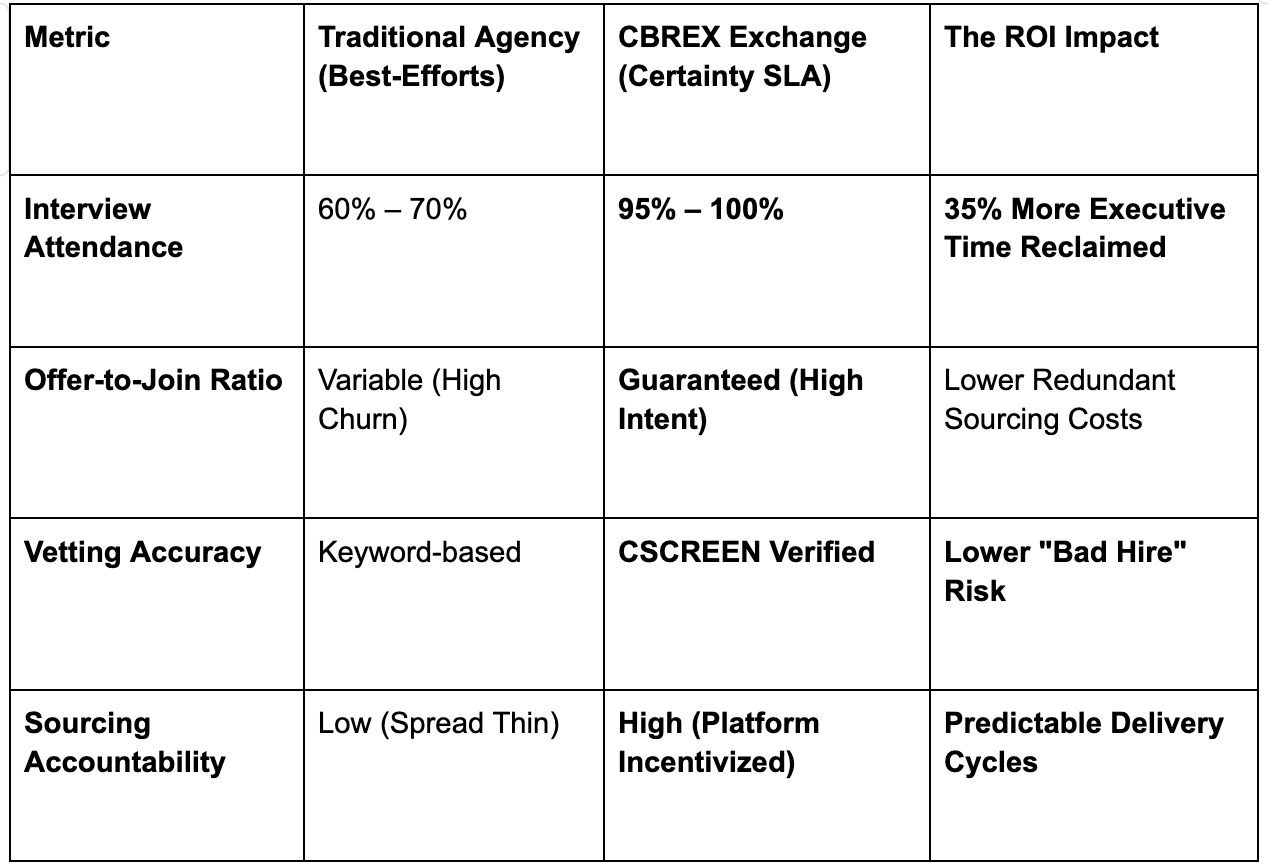
The Reliability Breakdown: "Best Efforts" vs. "Certainty SLA"

Data from the 2026 CBREX Reliability Index highlights the impact of data-driven intent validation.
The CBREX Pillars: Convenience, Certainty, and Accuracy

We’ve built our platform to act as the "Insurance Policy" for your talent pipeline:

  • Certainty (The Core Promise): We don't just "search" for candidates. We provide the Certainty of a vetted, high-intent shortlist that actually shows up.
  • Convenience: You get the Convenience of a single dashboard to track reliability scores across 5,000+ specialized vendors.
  • Accuracy: Our Accuracy and Precision layer (CSCREEN) ensures that "Intent" is backed by "Competency."

The Bridge: Moving from Hope to Hiring

In 2026, the companies that scale the fastest are those that have eliminated "Process Friction." By adopting the CBREX exchange model, you move away from the "Ghosting Crisis" and toward a predictable, high-integrity hiring engine.

Stop gambling on "Best Efforts." Start hiring with Certainty.
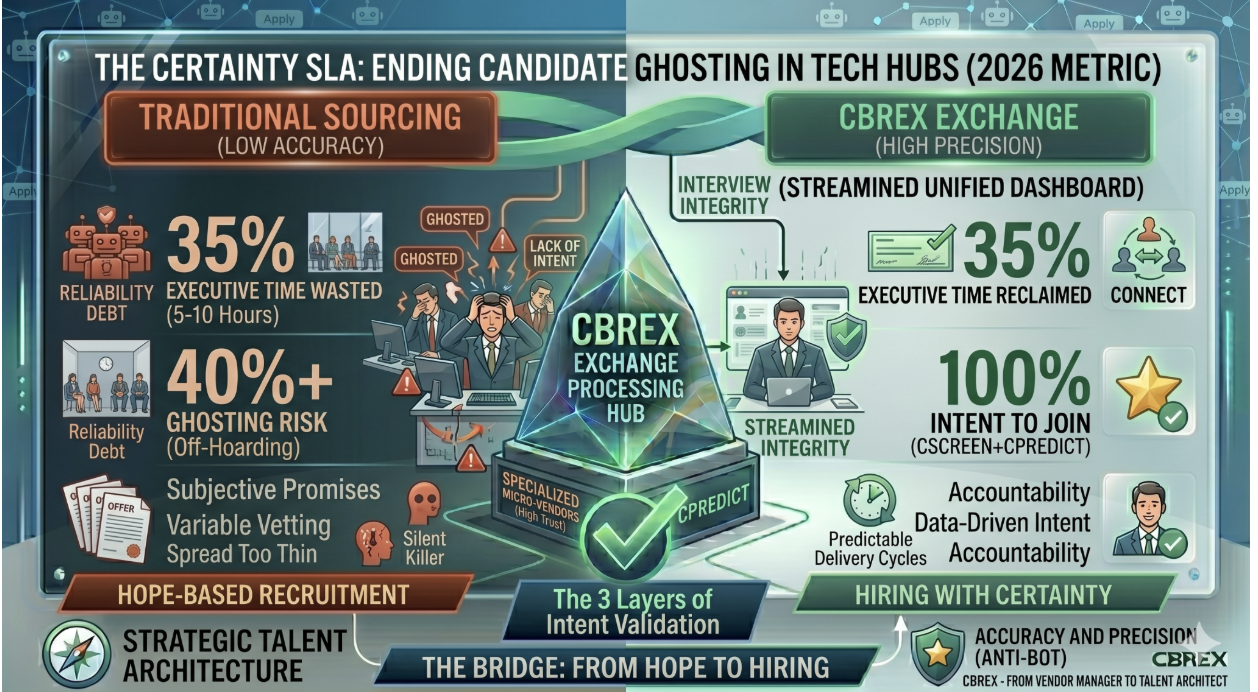
Table of contents

Sign up for regular updates
Get all the news delivered to your inbox.
Thank you! Your submission has been received!
Oops! Something went wrong while submitting the form.

Similar blogs

Read Time :
Managed Recruitment Services in India: 2026 Guide
A comprehensive service guide explaining what managed recruitment services actually include for India-based mid-market companies — covering how the model works end-to-end, what to expect from onboarding to first hire, how it differs from traditional agency or RPO models, and what a single-contract AI-powered approach looks like in practice. Addresses common questions around pricing, vendor coordination, SLAs, and how Indian companies across pharma, tech, and manufacturing are using it to hire specialist roles domestically and globally without retainers or admin chaos.
Read Time :
How Much Do Recruiters Charge as % of Salary?
A detailed cost guide breaking down how recruitment agencies calculate their fees as a percentage of annual salary — covering typical ranges (15–25%), what drives the percentage up or down (seniority, niche skills, geography, exclusivity), and how employers can benchmark and negotiate better rates. The blog also compares percentage-based fees against flat-fee and pay-on-hire models, helping TA leaders decide which pricing structure delivers the best cost-per-hire outcome for their specific hiring volume and role complexity.
Read Time :
How to Evaluate an RPO Provider: 10-Point Checklist
A practical, criteria-driven guide for TA and HR leaders on how to assess and shortlist RPO providers before signing a contract. Covers the 10 must-check criteria — including AI capability, specialist agency network depth, geographic coverage, fee transparency, ATS compatibility, and SLA accountability — along with red flags that signal a provider isn't equipped for complex or multi-country hiring. Positions CBREX's pay-on-hire, AI-matched RPO model as the benchmark for what a modern RPO evaluation should uncover.