Read Time:
19 Mins
RPO vs Managed Service: Which Model Fits Your Hiring Stage?


Most TA leaders at Indian mid-market companies reach the same fork in the road at some point during their global expansion journey. The hiring volume is growing. The vendor panel is sprawling. The CFO wants predictability. And someone in the leadership team has heard the words "RPO" and "managed service" and is now asking which one the company should adopt.
The honest answer is: it depends on where you are in your hiring maturity — and the wrong choice at the wrong stage is expensive to unwind. Recruitment process outsourcing vs managed service is not a simple better-or-worse comparison. These are two structurally different models with different cost profiles, different control dynamics, and different scalability ceilings. Choosing between them — or choosing neither — requires a clear-eyed look at what your TA function actually needs right now.
This guide maps out both models across the dimensions that matter most to TA leaders at India-founded companies hiring across multiple geographies: cost structure, control, scalability, vendor governance, and hiring stage fit. It also introduces a third model that many Indian mid-market companies are finding more practical than either.
Both RPO and managed service models are sold on the same promise: simplify your recruitment operations, reduce administrative burden, and improve hiring outcomes. That shared promise is exactly why the two get conflated. But the mechanisms are fundamentally different, and so are the trade-offs.
An RPO provider takes over your recruitment function, or a defined part of it. They embed a team, own the process, and deliver candidates. A managed service provider (MSP) does something different: they manage your external vendor ecosystem on your behalf. They don't source candidates directly. They govern the agencies that do.
For a TA leader at a Bengaluru-based mid-market company that has just opened entities in Singapore, the UAE, and Germany, neither description may sound like a perfect fit. That gap between what the models promise and what they actually deliver in a multi-geo, mid-market context is what this guide is designed to close.
Recruitment process outsourcing is the transfer of all or part of a company's recruitment function to an external provider. The RPO provider acts as an extension of your TA team, or, in full RPO engagements, replaces it entirely.
In a full RPO model, the provider typically owns sourcing strategy, candidate attraction, employer branding execution, ATS management, screening and shortlisting, interview scheduling, and compliance documentation. The internal TA team shifts from an operational role to a strategic oversight role.
RPO engagements are almost always structured around a management fee, a monthly retainer that covers the embedded team, plus a per-hire fee when placements are made. Some providers use a per-seat or per-requisition model. The key characteristic is that costs accrue whether or not hires are made. For companies with predictable, high-volume hiring, this is manageable. For companies with variable or experimental hiring needs, it creates fixed cost exposure.
For a deeper look at how agency and outsourcing fees stack up, see Recruitment Agency Cost in India: What You're Really Paying.
A managed service provider in recruitment is an intermediary that manages a company's external recruiting vendor ecosystem. The MSP does not source candidates directly. Instead, it governs the agencies that do, handling vendor onboarding, contract management, performance tracking, compliance, and consolidated invoicing.
MSPs typically charge a management fee calculated as a percentage of total recruitment spend (commonly 3-8%), or a flat monthly fee for the governance layer. This fee sits on top of the agency fees you're already paying. The MSP reduces administrative complexity, but it does not reduce the underlying cost of recruitment, it adds a layer to it.
The MSP model originated in contingent workforce management, managing contractors, temps, and statement-of-work engagements. It has since expanded into permanent hiring governance, particularly for large enterprises with 50+ active vendor relationships. For companies with significant vendor sprawl, an MSP can bring order to chaos. For companies with fewer than 20 active agencies, the overhead often outweighs the benefit.
Here is how the two models compare across the dimensions that matter most to TA leaders making this decision:
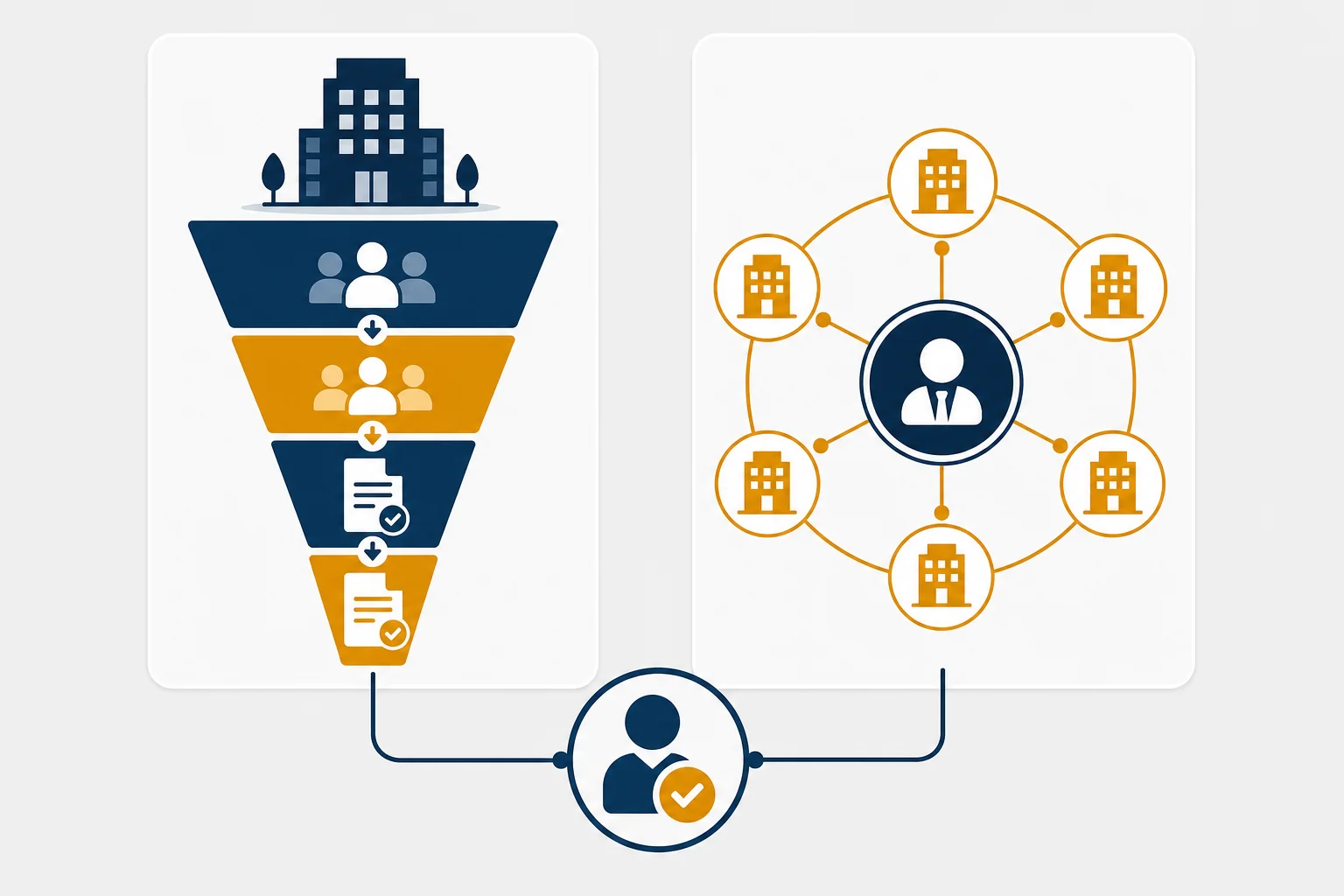
The overlap between the two models is real but narrow. Both reduce administrative burden. Both promise better hiring outcomes. But they achieve those outcomes through completely different mechanisms, and the right choice depends heavily on where your company sits in its hiring maturity curve.
Cost is usually the first dimension TA leaders examine, and it's where the two models diverge most sharply from each other, and from newer alternatives.
RPO cost reality: A full RPO engagement for a mid-market company typically involves a monthly management fee ranging from ₹8, 25 lakhs depending on team size and scope, plus a per-hire fee of 8-15% of CTC. The management fee accrues regardless of hiring volume. In months where hiring slows, due to budget freezes, market conditions, or role complexity, you're still paying for the embedded team.
MSP cost reality: The MSP management fee (typically 3-8% of total recruitment spend) is layered on top of the agency fees you're already paying. If your annual agency spend is ₹2 crore, an MSP adds ₹6, 16 lakhs in management overhead. You get better governance, but your cost-per-hire doesn't decrease, it increases slightly.
For Indian mid-market companies in the ₹50 crore to ₹5,000 crore revenue range, both models carry a cost structure that assumes a level of hiring volume and predictability that many companies at the early stages of global expansion simply don't have yet. A company opening its first office in Singapore or the UAE doesn't know whether it will make 10 hires or 40 hires in year one. Committing to an RPO retainer or an MSP management fee before that volume is established is a significant financial risk.
The alternative, a pay-on-hire marketplace model, eliminates this risk entirely. No retainers, no management fees, no seat licences. You pay only when a hire is made. For companies at the early stages of international hiring, this cost structure is materially more appropriate.
Control is the dimension that TA leaders often underestimate until they've lost it.
In a full RPO model, the provider owns the process. That means they own sourcing strategy, candidate selection criteria, screening methodology, and often the employer brand touchpoints candidates experience. For companies with strong employer brand equity or highly specific cultural fit requirements, this loss of control can be a serious problem. The RPO provider optimises for their SLAs, not necessarily for your hiring manager's nuanced preferences.
In an MSP model, the TA team retains strategic control. You decide which vendors are on the panel, what the rate cards are, and what the performance thresholds are. The MSP executes the governance. This is a better fit for companies that want to reduce administrative burden without surrendering hiring decisions. The trade-off is that you're still dependent on the quality of your vendor panel, the MSP manages the vendors, but it doesn't improve them.
For Indian companies hiring outside India, control over the hiring process in new markets is particularly important. A TA head in Mumbai briefing a role in Germany or the Philippines needs visibility into which agencies are working the role, what candidates are being surfaced, and why certain profiles are being prioritised. An RPO model that abstracts this away creates a black box at exactly the moment when market intelligence is most valuable.
Seamless ATS integration is critical here, whichever model you choose, you need full visibility into candidate status without switching between systems. Platforms that integrate natively with your existing ATS preserve control without adding operational overhead.
Scalability is where both traditional models show their structural limits most clearly, and where the needs of Indian mid-market companies going global are most poorly served.
RPO scalability: RPO scales well within a defined function or geography. A single-country RPO for tech hiring in India, for example, can be highly effective at volume. But multi-geo RPO, covering Singapore, Germany, the UAE, and Brazil simultaneously, requires either a global RPO provider with local embedded teams in each market, or a patchwork of regional RPO contracts. Global RPO providers exist, but they are expensive, typically require minimum annual hiring volumes of 200+ roles, and are designed for large multinationals rather than mid-market companies in early global expansion.
MSP scalability: An MSP can theoretically manage a vendor panel across any number of geographies, the governance layer is geography-agnostic. But the quality of outcomes depends entirely on the quality of the vendors on the panel. An MSP managing 40 agencies across 10 countries is only as good as those 40 agencies. If the panel doesn't include specialist firms with deep local market knowledge in each geography, the MSP governance layer adds cost without improving candidate quality.
For Indian mid-market companies hiring across countries like Poland, Romania, Vietnam, the UAE, and Brazil simultaneously, the practical challenge is not governance, it's access to the right specialist agencies in each market. Neither traditional RPO nor traditional MSP solves this problem efficiently.
The global hiring challenge for Indian companies is fundamentally a market access problem: how do you reach specialist talent in markets where you have no existing agency relationships, no employer brand presence, and no local HR infrastructure? A pre-built network of 4,000+ specialist agencies across 33 countries, accessible through a single contract, addresses this directly.
Both RPO and MSP are often sold as solutions to vendor sprawl, the accumulation of too many agency relationships, too many contracts, too many invoices, and too little performance visibility. The problem is real. Most mid-market companies that have been hiring for five or more years have 20, 50 agency relationships, of which perhaps 8, 12 are genuinely active and 3, 5 are actually performing.
RPO addresses vendor sprawl by replacing the vendor panel with an embedded team. The agencies go away; the RPO provider takes their place. This is a clean solution, but it's also a high-commitment one. If the RPO provider underperforms, you've dismantled your vendor relationships and have no fallback.
MSP addresses vendor sprawl by rationalising and governing the existing panel. Underperforming agencies are removed. Contracts are standardised. Invoicing is consolidated. This is a lower-commitment approach, but it doesn't solve the underlying quality problem, it just makes the existing panel easier to manage.
The most effective vendor consolidation approach for mid-market companies is a single-contract managed marketplace: one agreement that provides access to a curated network of specialist agencies, with AI-driven matching to route each role to the most relevant firms, and unified invoicing across all placements. This eliminates vendor sprawl without requiring either the commitment of RPO or the overhead of MSP.
For a detailed look at how to approach this, see How to Build a Consolidated Recruitment Vendor Pool and Vendor Consolidation in Recruitment: Top 10 Questions Answered.
The most useful framework for this decision is not a feature comparison, it's a hiring maturity assessment. Different models are appropriate at different stages of a company's global hiring journey.

At this stage, your company is opening its first or second international entity. Hiring volumes are low and unpredictable. You don't yet know which roles will be hardest to fill, which markets will require specialist agencies, or what your employer brand looks like to candidates in those markets.
RPO fit: Poor. The fixed cost structure is unjustifiable at this volume. Most RPO providers won't engage at this scale, and those that do will charge premium rates for low-volume engagements.
MSP fit: Poor. You don't have enough vendors to justify a governance layer. An MSP managing 3, 5 agencies is administrative overhead, not value creation.
Best fit: An AI-powered marketplace with pay-on-hire pricing. Access to specialist agencies in each target market, no retainer commitment, and full visibility into the process.
At this stage, your company has established international entities and is hiring regularly across multiple markets. Vendor relationships are accumulating. Invoice management is becoming a burden. You need governance without the rigidity of full RPO.
RPO fit: Moderate, for specific high-volume functions (e.g., tech hiring in one geography). Not suitable as a global solution at this stage.
MSP fit: Moderate, if you already have a large vendor panel. But if your panel is small or underperforming, MSP governance won't fix the underlying quality problem.
Best fit: A managed marketplace that combines vendor access, AI matching, and consolidated invoicing, effectively delivering the governance benefits of MSP with the specialist access of a curated agency network, at pay-on-hire pricing.
At this stage, your company has significant hiring volume across multiple geographies. Predictability and process consistency are priorities. You have the scale to justify RPO for high-volume, repeatable functions.
RPO fit: Strong, for defined high-volume functions. End-to-end RPO for tech hiring or shared services hiring at this scale delivers genuine efficiency.
MSP fit: Strong, for contingent workforce management and vendor panel governance across a large, established agency ecosystem.
Best fit: A hybrid approach, RPO for high-volume repeatable functions, marketplace for niche and specialist roles that require deep local market knowledge.
The honest assessment of the RPO vs managed service debate is that neither model was designed with the Indian mid-market global expansion use case in mind. RPO was designed for large multinationals with high-volume, predictable hiring. MSP was designed for enterprises managing large contingent workforces. The mid-market company hiring 80 roles across 6 countries, a mix of tech, finance, operations, and leadership roles, sits in a gap that neither model serves well.
The model that does serve this use case is what CBREX calls an AI-powered managed marketplace: a platform that combines the specialist agency access of a curated network, the governance benefits of a managed service, and the cost efficiency of a pay-on-hire model, all through a single contract.
When a role is posted on CBREX, the platform's AI matching engine (C Map) routes the requirement to the most relevant specialist agencies from a network of 4,000+ firms across 33 countries. Agencies compete to fill the role. Submitted candidates go through a three-level screening process: agency pre-screen, AI validation via C Screen (trained on 250,000+ anonymised resumes across 570+ job categories), and stack ranking. The TA team receives a shortlist of pre-screened, interview-ready candidates, without managing the agency relationships, the invoicing, or the compliance documentation.
The cost model is pure pay-on-hire. No retainers. No management fees. No seat licences. You pay when a hire is made.
For TA leaders comparing RPO vs agency models for mid-market companies, the managed marketplace sits in a distinct category, it's not a replacement for either model in every scenario, but it's the most practical starting point for companies at Stage 1 or Stage 2 of global hiring maturity.
If you're also evaluating how AI fits into your broader hiring stack, the guide on choosing the right AI resume screening tool covers the quality control dimension in detail.
Generally, no. RPO providers build their sourcing capability around volume and repeatability. Niche roles, a regulatory affairs specialist in Germany, a fintech compliance lead in Singapore, require deep local market knowledge and specialist agency relationships that most RPO providers don't maintain at the required depth. For niche hiring, a specialist agency network with AI matching typically outperforms both RPO and MSP.
Yes, but the value depends on the size of your vendor panel. If you have fewer than 15 active agencies, the MSP governance layer adds cost without proportionate value. MSP is most effective when you have 25+ active vendors generating significant administrative overhead. Small TA teams with limited vendor panels are better served by a managed marketplace that handles vendor management as part of the platform service.
Most RPO providers require a minimum of 75, 100 hires per year to make the engagement commercially viable for both parties. Below that threshold, the management fee per hire becomes disproportionately high. Project RPO engagements can work at lower volumes for defined time periods, but they carry the same fixed cost risk during the engagement window.
A traditional MSP governs your existing vendor panel, it manages the agencies you already have. CBREX provides access to a pre-built network of 4,000+ specialist agencies across 33 countries, routes roles to the most relevant firms via AI matching, applies three-level candidate screening, and consolidates all invoicing under a single contract. You don't need an existing vendor panel. You don't pay a management fee. And you only pay when a hire is made. It's a fundamentally different value proposition, closer to a managed marketplace than a traditional MSP.
Yes, and for companies at Stage 3 of global hiring maturity, this is often the optimal approach. RPO handles high-volume, repeatable hiring in core geographies. The marketplace handles niche, specialist, and multi-geo roles that fall outside the RPO provider's core capability. The two models are complementary rather than competitive when scoped correctly.
The recruitment process outsourcing vs managed service decision is ultimately a question of hiring maturity, not model superiority. RPO is a powerful tool for companies with high-volume, predictable hiring at scale. MSP is a valuable governance layer for enterprises managing large, fragmented vendor panels. But for the majority of Indian mid-market companies currently navigating global expansion, hiring across 3, 10 countries with variable volumes and niche skill requirements, neither model is the right starting point.
The smarter move is to start with a model that gives you specialist agency access across every target market, AI-driven quality control, full TA team visibility, and zero upfront cost commitment. Build the hiring data and volume history that will eventually justify RPO or MSP investment. Don't commit to a fixed-cost model before you have the volume to support it.
If your TA team is currently managing fragmented agency relationships across multiple geographies, or struggling to fill niche roles in markets where you have no existing agency network, book a demo with CBREX to see how the managed marketplace model works in practice. Or if you're ready to start immediately, sign up and post your first role, no retainer, no contract commitment, no upfront fees. You pay only when you hire.
Not sure which model fits your current hiring stage? Let's talk, a 30-minute conversation with our team will map your current hiring footprint to the right model and give you a clear view of what the transition looks like.


