Read Time:
18 Mins
How to Hire in Southeast Asia from India (2026)
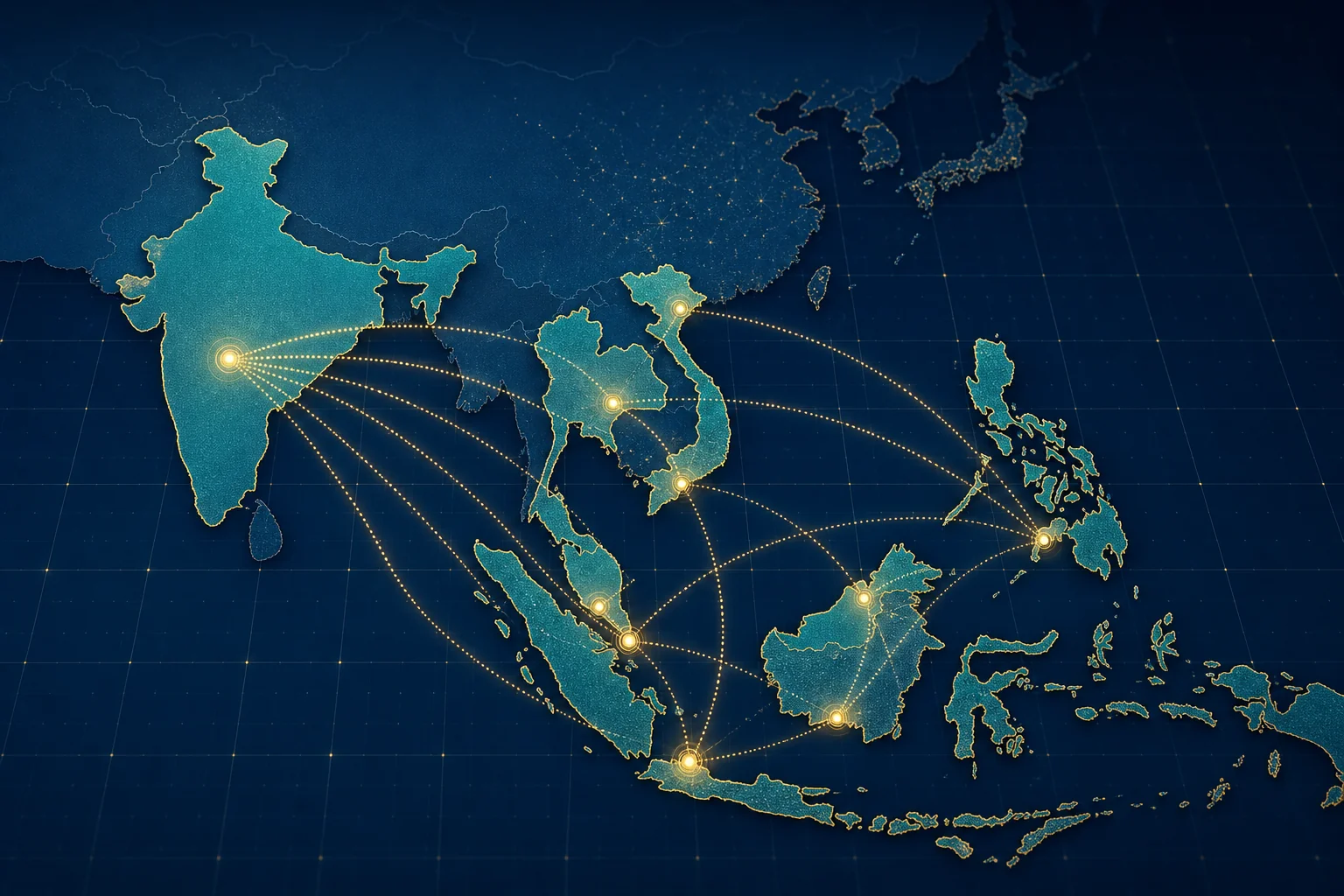

The Singapore entity needed a compliance lead. The Manila office needed a senior Java developer. The Kuala Lumpur team needed a finance manager. All three roles were approved on the same day — and the TA head at a Bengaluru-based mid-market company had no idea where to start. Her agency panel covered India well. It covered nothing else.
That scenario plays out constantly across Indian mid-market and enterprise companies expanding into Southeast Asia. The ambition is real. The hiring infrastructure to support it often isn't. This guide is built for exactly that situation: a practical, country-by-country breakdown of how to hire in Southeast Asia from India — covering Singapore, Malaysia, Philippines, Vietnam, Indonesia, and Thailand — without building a local HR team in every market.
Southeast Asia has become a priority expansion region for Indian companies across sectors. Technology firms are setting up GCCs in Singapore and Kuala Lumpur. Pharma and manufacturing companies are building regional operations in Vietnam and Indonesia. SaaS companies are hiring sales and customer success talent across Manila and Bangkok. The region's combination of English-speaking talent pools, competitive salary benchmarks, and proximity to India (just 1.5 to 3.5 hours ahead in time zones) makes it a natural first step for Indian companies going global.
But proximity on a map doesn't mean proximity in hiring practice. Each of the six major SEA markets has its own labor laws, talent concentration patterns, agency ecosystems, and candidate expectations. An Indian company that treats Southeast Asia as a single hiring market will lose candidates, waste budget, and frustrate hiring managers. The companies that get it right treat each country as a distinct market, and build their sourcing strategy accordingly.
For a broader view of what Indian companies face when hiring outside India across all regions, the Global Hiring from India: The 2026 Complete Guide covers the full picture. This post goes deeper on SEA specifically.
The single biggest mistake Indian companies make when hiring in Southeast Asia is writing one job description and briefing one agency for all markets. Here's what each market actually looks like on the ground.
Singapore is the most competitive and expensive talent market in SEA. English is the primary business language. The talent pool is strong in financial services, technology, compliance, and regional management roles. Expect salary benchmarks significantly higher than India, and a candidate market where top professionals receive multiple offers simultaneously. Time-to-hire for specialist roles typically runs four to eight weeks. Boutique specialist agencies outperform generalist firms here.
Malaysia offers a bilingual (English and Bahasa Malaysia) talent pool at a lower cost than Singapore. Kuala Lumpur and the Klang Valley are the primary talent hubs. The country has a strong shared services sector, making it a good market for finance, HR, and operations roles. Manufacturing talent is concentrated in Penang and Johor. Local agency relationships matter, regional firms with Singapore headquarters often underperform on Malaysian mandates.
The Philippines has one of the largest English-speaking workforces in Asia. Metro Manila dominates the talent market. The country's BPO heritage means deep talent pools in customer success, finance and accounting, and technology. Tech talent in particular has grown significantly, with strong Java, Python, and cloud skills available at competitive rates. Filipino candidates respond well to structured hiring processes and clear role briefs.
Vietnam is one of the fastest-growing tech and manufacturing talent markets in SEA. Ho Chi Minh City and Hanoi have distinct talent profiles, HCMC leans toward tech and commercial roles, Hanoi toward government-adjacent and manufacturing. English proficiency is improving but remains a consideration for senior roles. Local specialist agencies with bilingual capabilities are essential. Salary expectations are rising fast as demand outpaces supply.
Indonesia is the largest economy in SEA, but its talent market is heavily Jakarta-centric. Bahasa Indonesia is the primary business language for most roles below regional director level. Manufacturing, consumer goods, and financial services are the strongest talent sectors. Indian companies often underestimate the importance of local language job descriptions and local agency relationships here.
Thailand is a strong market for automotive, manufacturing, and industrial talent. Bangkok dominates. English proficiency among senior professionals is reasonable, but mid-level roles often require Thai language capability. The agency ecosystem is mature for manufacturing and engineering roles, less so for tech. Expect longer hiring timelines for niche specialist roles.
The practical implication: your JD, your sourcing channel, and your agency brief need to be tailored per country. A generic "regional" approach will produce generic results.
Employment law across Southeast Asia is not harmonized. Each country has its own framework, and the gaps between them are significant. Indian companies hiring across multiple SEA markets simultaneously face real compliance exposure if they treat this as an afterthought.
The most common compliance risk for Indian companies is worker misclassification, treating employees as contractors to avoid local employment obligations. This is heavily penalized across all six markets. The second most common risk is failing to register for mandatory social contributions from day one of employment.
If you're hiring one or two people in a new SEA market, an Employer of Record (EOR) is almost always the right starting point. The EOR becomes the legal employer in-country, handles payroll, benefits, and compliance, and removes the need to incorporate a local entity. Once headcount in a market exceeds eight to ten people, the economics of a local entity typically improve. For a detailed breakdown of cross-border compliance considerations, the Pharma Manufacturing Cross-Border Hiring: A 5-Country Playbook covers the compliance layer in depth for regulated industries.
One underappreciated benefit of working with specialist local recruiting agencies: they know the local compliance landscape. A good Singapore-based specialist agency will flag MOM requirements before you make an offer. A Manila-based agency will remind you about DOLE regularization timelines. This local knowledge is part of what you're paying for, and it's not something a generalist Indian agency can replicate.
The best candidates in Southeast Asia are not refreshing job boards. They're employed, performing well, and not actively looking. Reaching them requires a fundamentally different sourcing approach than posting on Naukri or LinkedIn India.

Indian job boards have near-zero reach into SEA passive talent pools. Even LinkedIn, while global, surfaces active job seekers disproportionately, the passive candidates who would be a strong fit for your role are not responding to InMails from an India-based recruiter they've never heard of. This is where specialist local agencies become the critical sourcing layer.
A specialist agency in Singapore that has placed twenty compliance leads in the last two years has something no job board can replicate: a warm network of candidates who trust them. When that agency calls a passive candidate about your role, the call gets answered. When an unknown recruiter from India sends a LinkedIn message, it doesn't.
The challenge for Indian companies is finding and vetting the right specialist agencies across six different markets simultaneously. This is where AI vendor matching changes the equation. CBREX's C Map technology routes your job requirement to the most relevant specialist agencies per country, not generalist firms, not agencies that cover everything and excel at nothing. The matching is based on actual placement history, not self-reported capability.
For a deeper look at why passive sourcing strategies fail when built on the wrong infrastructure, see Passive Talent Sourcing Strategy: Fix What's Failing.
Many Indian companies try to solve the SEA sourcing problem by briefing one large regional agency, a firm with offices in Singapore, KL, and Manila. The logic is sound: one relationship, one contract, one point of contact. The reality is usually disappointing. Regional generalist agencies spread their effort across too many markets and too many role types to build genuine specialist depth in any of them. You get coverage, not quality.
The better model is a curated network of specialist agencies per market, coordinated through a single platform. One contract. One invoice. But the actual sourcing done by firms that know their local market deeply.
Imagine hiring across Singapore, Malaysia, Philippines, Vietnam, Indonesia, and Thailand simultaneously. That's potentially six different agency contracts, six different fee structures, six different invoicing currencies, and six different reporting formats, all landing on one TA team in India.

This is vendor sprawl at its most acute. And it's not just an administrative inconvenience, it has real costs. According to CBREX's own data from clients managing multi-country hiring, TA teams spend an average of 30-40% of their time on vendor coordination rather than actual hiring decisions. That's time not spent on candidate evaluation, hiring manager alignment, or offer management.
For a full breakdown of what fragmented agency management actually costs, Recruitment Agency Cost in India: What You're Really Paying quantifies the hidden costs in detail.
CBREX's model addresses vendor sprawl directly. One agreement covers access to 4,000+ specialist recruiting firms across 33 countries, including all six major SEA markets. Invoicing is unified. SLAs are standardized. And the AI matching layer ensures the right specialist agency is activated per role, per country, without the TA team having to manage individual agency relationships.
For Indian companies that have already accumulated a fragmented vendor panel, How to Build a Consolidated Recruitment Vendor Pool covers the consolidation process step by step.
Once your sourcing infrastructure is in place, execution comes down to market-specific tactics. Here's what works in each of the six SEA markets for Indian companies.

Singapore's talent market moves fast. Top candidates in finance, technology, and compliance typically have multiple offers within two to three weeks of entering the market. Your hiring process needs to match that pace. Use boutique specialist agencies with deep networks in your specific function. Expect agency fees in the 15-20% of annual salary range. Be prepared to make decisions quickly, a two-week deliberation period will cost you the candidate.
Malaysia offers strong talent at lower cost than Singapore, particularly for shared services, finance operations, and mid-level technology roles. The Klang Valley (KL and surrounding areas) is where most talent is concentrated. Local agencies with Klang Valley networks outperform regional firms. Salary benchmarks are roughly 40-60% of Singapore equivalents for comparable roles. Hiring timelines are typically six to ten weeks for specialist roles.
The Philippines has a mature agency ecosystem, particularly for technology, finance and accounting, and customer success roles. Metro Manila is the primary talent hub, though Cebu and Davao have growing tech communities. Filipino candidates respond well to structured, communicative hiring processes. Keep candidates informed at every stage, ghosting after interviews is a significant reason Indian companies lose Filipino candidates. Expect agency fees of 12-18% of annual salary.
Vietnam's tech talent market has grown dramatically over the past five years. Ho Chi Minh City leads in commercial and tech roles; Hanoi has stronger manufacturing and government-adjacent talent. Local language capability in your agency partner is non-negotiable, English-only agencies miss a significant portion of the passive talent pool. Salary expectations are rising 15-20% year-on-year in tech. Move quickly when you find the right candidate.
Indonesia requires the most localization of any SEA market. Job descriptions in Bahasa Indonesia significantly outperform English-only JDs for mid-level roles. Jakarta accounts for the majority of professional talent, though Surabaya and Bandung have growing pools in manufacturing and technology. Local agency relationships are critical, international firms without genuine Jakarta presence struggle to reach passive candidates. Compliance requirements (BPJS registration, local contract formats) need to be in place before you make an offer.
Thailand's strongest talent sectors are automotive, manufacturing, and industrial engineering, Bangkok and the Eastern Economic Corridor (EEC) are the key hubs. Tech talent is growing but remains thinner than in Vietnam or the Philippines. For manufacturing and engineering roles, specialist Thai agencies with factory-floor networks are essential. For tech roles, expect longer timelines and consider Vietnam or Philippines as complementary sourcing markets.
One of the most underappreciated challenges of multi-country SEA hiring is quality inconsistency. An agency in Singapore and an agency in Jakarta will have very different definitions of "pre-screened." Without a consistent quality layer, your hiring managers in India end up reviewing CVs of wildly varying quality, and losing confidence in the process.
The solution is a standardized screening layer that sits above all agency submissions, regardless of market. CBREX's C Screen AI, trained on 250,000+ anonymized resumes across 570+ job categories, applies a consistent quality bar to every CV submitted, whether it comes from a Singapore boutique or a Manila generalist. The result is a stack-ranked shortlist of interview-ready candidates, not a pile of unfiltered submissions.
The three-level screening model works as follows: the specialist agency does their own pre-screen based on local market knowledge, C Screen AI validates against the role requirements and flags inconsistencies, and the final shortlist is stack-ranked for the hiring manager. This means your India-based hiring manager receives candidates who have passed two independent quality checks before they see a single CV.
For more on how AI screening works in practice, AI Resume Screening: How to Choose the Right Tool in 2026 covers the evaluation criteria in detail.
The time zone advantage is real and underused. India Standard Time sits just 1.5 hours behind Singapore and Malaysia, 1.5 hours behind the Philippines, and 2.5 hours behind Vietnam, Indonesia, and Thailand. This means a full working day overlap with every SEA market, something Indian companies hiring in MENA or Europe don't have. Use it.
If your SEA hiring isn't visible in your ATS, it doesn't exist as far as your leadership team is concerned. CBREX integrates with all major applicant tracking systems, so every candidate submission, every stage update, and every offer status across all six SEA markets is visible in the same system your India hiring runs through. No separate spreadsheets. No weekly agency update calls. One pipeline view.
For companies evaluating their full hiring tech stack, Hiring Platforms India: Job Boards vs. Agencies vs. AI Marketplaces provides a useful framework for deciding where each tool fits.
If your SEA hiring volume exceeds ten to fifteen roles per quarter across multiple markets, managing it as a series of individual requisitions becomes inefficient. This is where AI-powered RPO makes sense, a model where CBREX manages the full recruitment process across all SEA markets, coordinating specialist agencies, screening candidates, and delivering interview-ready shortlists, while your India TA team focuses on hiring decisions rather than process management.
The RPO model is particularly effective for Indian companies that are scaling SEA operations quickly and don't have the bandwidth to build local HR infrastructure in each market. For a comparison of RPO and agency models, RPO vs Agency India: Which Model Wins for Mid-Market Companies breaks down the decision criteria.
One of the biggest barriers to hiring in new SEA markets is the upfront cost. Traditional retained search firms want a retainer before they start work, in a market you've never hired in before, that's a significant financial commitment with uncertain returns. CBREX's pay-on-hire model removes that barrier entirely. You pay only when a hire is made. No retainers. No seat licences. No upfront fees. For Indian companies testing a new SEA market for the first time, this changes the risk calculus completely.
Not necessarily. For small headcounts (one to five people) in a new SEA market, an Employer of Record (EOR) is typically the most practical and cost-effective solution. EORs handle local employment contracts, payroll, and compliance without requiring you to incorporate locally. Once your headcount in a market grows to eight to ten people, the economics of a local entity usually improve. Your EOR provider can advise on the right transition point.
Singapore typically runs four to eight weeks for specialist roles, assuming a fast hiring process on your side. Vietnam can run six to twelve weeks, partly due to the need for bilingual sourcing and the fast-moving nature of the tech talent market. The Philippines is often the fastest market for English-speaking tech and finance roles, four to six weeks is achievable with a good specialist agency. Indonesia and Thailand tend to run eight to twelve weeks for specialist roles.
Agency fees across SEA generally range from 12% to 20% of annual salary for permanent placements, depending on the market and role seniority. Singapore and Malaysia tend toward the higher end of that range for specialist roles. Philippines and Vietnam are typically in the 12-15% range. These are contingency fees, you pay only on successful placement. Retained search for senior leadership roles commands higher fees and upfront payments, which is why the pay-on-hire model is particularly valuable for SEA expansion.
In practice, no single agency has genuine specialist depth across all six SEA markets. Regional agencies with offices in multiple countries tend to be generalists, they cover the geography but lack the deep local networks needed to reach passive candidates in each market. The better approach is a curated network of specialist agencies per country, coordinated through a single platform and contract. This gives you local depth without the administrative burden of managing six separate agency relationships.
CBREX connects Indian companies to a network of 4,000+ specialist recruiting firms across 33 countries, including all six major SEA markets, through a single contract and unified invoicing. When you post a role, CBREX's AI (C Map) matches it to the most relevant specialist agencies in that specific market. C Screen AI then validates all submissions against a consistent quality standard. Your India TA team gets interview-ready shortlists without managing individual agency relationships, multi-currency invoices, or separate SLA negotiations. There are no retainers and no upfront fees, you pay only when a hire is made.
Southeast Asia is not a single market. It's six distinct talent ecosystems, each with its own compliance framework, sourcing dynamics, and candidate expectations. Indian companies that treat it as one will struggle. Those that build a market-specific approach, with the right specialist agencies, consistent screening, and unified contract management, will hire faster, better, and at lower cost.
The infrastructure to do this doesn't require a local HR team in every country. It requires the right platform. CBREX gives Indian mid-market and enterprise companies access to specialist agencies across all six SEA markets through one agreement, with AI-powered matching and screening that delivers interview-ready candidates, and a pay-on-hire model that removes the upfront risk of entering new markets.
If your company is ready to build a serious SEA hiring capability from India HQ, book a demo with CBREX to see how the platform handles multi-country SEA hiring end to end. Or if you'd prefer to talk through your specific markets and roles first, reach out directly, the team works with Indian companies at every stage of their SEA expansion, from first hire to full-scale operations.
You can also sign up on CBREX and post your first SEA role today, no retainer, no commitment until you hire.


