Read Time:
17 Mins
How to Choose a Recruitment Marketplace in India


Your TA team just got approval for 30 hires. Eight are specialist roles in India. Twelve span Japan, Germany, and the UAE. The remaining ten are scattered across Brazil, Singapore, and Kenya. You have three months, one internal recruiter, and a list of agency contacts that hasn't been updated since 2023.
This is the moment most TA leaders at Indian mid-market companies realise they need more than a better agency — they need a better platform. But choosing a recruitment marketplace platform is its own challenge. The market is crowded, the claims are loud, and the differences between platforms only become visible after you've signed a contract and started hiring.
This guide gives you a structured, criteria-by-criteria framework to evaluate and shortlist recruitment marketplace platforms — so you make the right call before you commit, not after.
For years, the standard advice to Indian HR teams was: "Find better agencies." Vet them carefully, build relationships, keep a panel of six to ten firms, and manage them closely. That advice made sense when hiring was mostly domestic and mostly predictable.
The problem is that Indian companies are no longer hiring that way. Mid-market firms are expanding into Southeast Asia, the Middle East, Eastern Europe, and Latin America. GCCs are scaling headcount across multiple geographies simultaneously. Niche roles — regulatory affairs in Germany, embedded systems engineers in Japan, compliance leads in Brazil, don't get filled by generalist agencies with a job board subscription.
The result is vendor sprawl: twelve agencies on the panel, four of them active, two of them actually filling roles. Separate contracts, separate invoices, separate SLAs, and a TA team spending more time managing recruiters than hiring talent. The platform you choose determines whether that problem gets solved or just reshuffled.
A well-chosen recruitment marketplace replaces the agency management burden with a single interface, a single contract, and AI-driven matching that routes your roles to the specialist firms most likely to fill them. A poorly chosen one adds another subscription fee to your stack without changing the underlying dynamic.
Here is how to tell the difference.
Before you open a single vendor conversation, build a requirements list. Platforms are optimised for different use cases, and the one that works brilliantly for a Bengaluru-based startup hiring 50 junior engineers will not necessarily serve a Pune-based pharma company hiring regulatory specialists across five countries.
Work through these questions with your TA team:
Document your answers before you start evaluating. This list becomes your scoring rubric. Every platform you assess should be measured against your specific requirements, not against a generic feature checklist from a vendor's website.
For a broader view of how different hiring models compare before you narrow to a platform, this breakdown of job boards, agencies, and AI marketplaces in India is a useful starting point.
Every recruitment platform in 2026 claims to use AI. The question is: AI doing what, exactly?
There are two meaningfully different applications of AI in recruitment marketplaces. The first is AI vendor matching, the system that routes your job requirement to the most relevant specialist agencies on the platform. The second is AI resume screening, the system that evaluates candidate CVs before they reach your hiring managers.
Both matter. But most platforms only do one well, and many do neither with any real precision.
Ask the platform: how does your system decide which agencies receive my job requirement? If the answer involves keywords, manual assignment, or "our team reviews it," that is not AI matching, that is a staffing agency with a software interface. Genuine AI vendor matching uses historical placement data, agency specialisation profiles, and role-specific signals to route requirements to the firms most likely to fill them.
CBREX's C Map tool does exactly this. When a role is posted, C Map analyses the requirement against the placement history and specialisation depth of 4,000+ agencies across 33 countries, then routes it to the firms with the strongest track record for that specific function, seniority level, and geography. The result is faster shortlists and higher offer-acceptance rates, because the agencies working your role are the ones who actually know that market.
Ask the platform: what is your screening accuracy rate, and what data was it trained on? Vague answers ("our AI is very accurate") are a red flag. Credible platforms can tell you the training dataset size, the job categories covered, and the false-positive rate.
CBREX's C Screen tool is trained on 250,000+ anonymised resumes across 570+ job categories, with a stated accuracy rate of 98%. That specificity matters, it means the AI has seen enough real-world hiring data to distinguish a genuinely qualified candidate from a CV that has been optimised to pass keyword filters. For more on what AI screening accuracy actually means in practice, see this guide to choosing the right AI resume screening tool.
Network size is the most commonly cited metric in recruitment marketplace marketing. "Access to 10,000 recruiters" sounds impressive until you ask how many of those recruiters have ever placed a regulatory affairs specialist in Germany or a supply chain lead in Vietnam.
Specialist depth matters more than raw headcount. A platform with 500 deeply specialised agencies across your target geographies will outperform a platform with 10,000 generalist firms every time you have a hard-to-fill role.
CBREX's network of 4,000+ specialist recruiting firms spans 33 countries, with agencies vetted for specialisation depth and placement track record before they are admitted to the platform. This is not a directory of every recruiter who signed up, it is a curated network built specifically for hard-to-fill and cross-border roles.
For Indian companies expanding globally, geographic coverage is the critical variable. The platform needs to have genuine specialist presence in the markets you are entering, not just a flag on a map. CBREX covers North America, LATAM, MENA, SEA, EMEA, APAC, Eastern Europe, Western Europe, the UK, China, Japan, and Oceania, with specialist agencies in each region.
Pricing model is where recruitment marketplace platforms diverge most sharply, and where the wrong choice creates the most financial risk.
Traditional executive search firms charge a retainer: an upfront fee paid before any candidate is presented, with the balance due on placement. You pay regardless of outcome. For niche leadership roles where the search is genuinely complex, retainers can be justified. For most mid-market hiring, they represent significant upfront risk with no guarantee of a hire.
Some platforms charge seat licences, platform access fees, or monthly subscriptions, costs you incur whether you make hires or not. These models work well for platforms that deliver consistent, high-volume value. They become expensive when hiring slows, when roles go unfilled, or when the platform's agency network doesn't cover your specific needs.
Pay-on-hire means you only pay a placement fee when a candidate accepts an offer and joins. No upfront costs, no retainers, no subscription fees. The platform's incentive is perfectly aligned with yours: they only earn when you hire.
CBREX operates on a pure pay-on-hire model. There are no retainers, no seat licences, and no platform fees. You post roles, the AI matches them to specialist agencies, and you pay only when a hire is made. For Indian mid-market companies managing unpredictable hiring volumes or entering new geographies, this model eliminates financial risk entirely.
For a detailed breakdown of what different recruitment pricing models actually cost, this analysis of recruitment agency costs in India covers the full picture, including the hidden fees that rarely appear in headline quotes.
Contract structure is the operational detail that most TA leaders overlook during platform evaluation, and the one that creates the most administrative pain after they sign.

Traditional agency management means a separate contract with every firm on your panel. Each contract has its own terms, its own fee structure, its own replacement guarantee clause, and its own invoicing cycle. When you are managing eight agencies across four countries, that is eight contracts to negotiate, eight invoices to reconcile, and eight sets of legal terms to keep current.
Single-contract coverage changes this entirely. One agreement with the platform covers every agency in the network. You negotiate once, sign once, and every subsequent hire, regardless of which agency placed the candidate or which country the role was in, falls under the same terms.
CBREX's single-contract model covers all 4,000+ agencies across 33 countries. One agreement. One invoicing relationship. One set of terms. For Indian companies hiring across multiple geographies, this is not just an administrative convenience, it is a compliance simplification that reduces legal exposure and finance team overhead simultaneously.
Pair this with unified invoicing, one invoice per billing cycle regardless of how many agencies placed candidates, and the operational burden of multi-agency, multi-country hiring drops dramatically.
A recruitment marketplace that doesn't integrate with your existing ATS creates a parallel workflow, and parallel workflows create data gaps, duplicate effort, and frustrated hiring managers.
Before you shortlist any platform, confirm the following:
CBREX integrates seamlessly with all major applicant tracking systems. The integration is designed to fit into your existing workflow rather than replace it, candidate profiles, screening results, and status updates flow directly into your ATS without manual intervention.
This matters particularly for TA teams that have invested in configuring their ATS for specific workflows. A platform that forces you to abandon that configuration is adding cost, not reducing it.
For Indian companies expanding globally, this is the criterion that eliminates most platforms from consideration.
Domestic recruitment platforms, including most Indian job boards and many agency networks, are built for India-based hiring. They may have a "global" tab or a list of international partner agencies, but their actual placement track record outside India is thin. When you post a role in São Paulo or Osaka, you are effectively testing whether the platform has genuine specialist presence in that market or just a nominal listing.
CBREX was built specifically for this use case. The platform's 33-country specialist network covers the geographies most relevant to Indian mid-market companies going global: Japan, Germany, the UAE, Singapore, Brazil, the UK, the USA, Australia, South Korea, Hong Kong, Kenya, Bangladesh, Nepal, Mexico, and more. Each country is covered by specialist agencies with genuine local market depth, not generalist firms parachuted in from a global network.
For a comprehensive view of what global hiring from India actually involves, this complete guide to global hiring from India covers the operational, compliance, and sourcing dimensions in detail.
The volume of unscreened CVs is one of the most consistent complaints from hiring managers at Indian enterprises. Agencies send whoever they have. Job boards surface whoever applied. The hiring manager spends two hours reviewing fifteen CVs to find two worth interviewing, and that is before accounting for candidates who have optimised their resumes for keyword filters rather than genuine fit.
A recruitment marketplace should solve this problem, not replicate it at scale.
CBREX uses a three-level screening process before any candidate reaches a hiring manager:
The result is interview-ready shortlists, candidates who have been qualified by a specialist human recruiter and validated by AI before they reach your hiring manager's desk. This is the difference between a recruitment marketplace and a job board with an AI badge.
Slow time-to-fill is often a screening problem as much as a sourcing problem. When hiring managers spend hours reviewing unqualified CVs, the entire hiring cycle slows down. For a detailed look at what that delay actually costs, this analysis of the hidden cost of roles left open puts numbers to the problem.
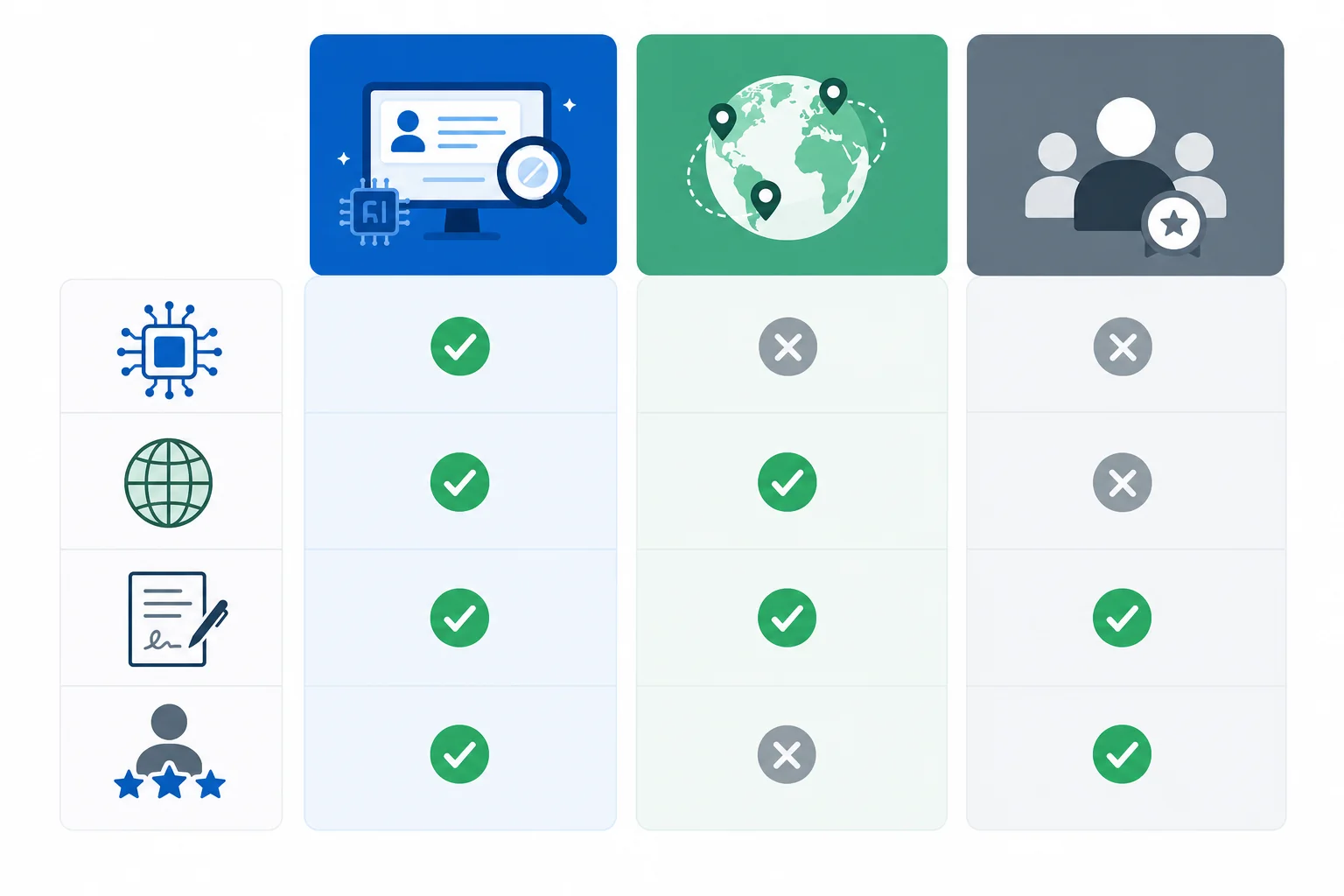
Use this framework to score platforms against your requirements. Rate each criterion based on what the vendor demonstrates, not what they claim in a sales deck.
| Evaluation Criterion | Recruitment Marketplace (e.g., CBREX) | Traditional Agency | Job Board |
|---|---|---|---|
| Pricing model | Pay-on-hire, no upfront fees | Retainer + placement fee | Subscription or job posting fee |
| Agency network depth | 4,000+ specialist firms, 33 countries | Single firm, limited geography | No agency network |
| AI matching | AI routes roles to best-fit agencies | Manual assignment | Keyword-based search |
| Resume screening | 3-level: agency + AI + stack ranking | Agency pre-screen only | None, applicant self-selects |
| Contract structure | Single contract, all agencies | Separate contract per agency | Platform subscription only |
| ATS integration | Seamless, all major ATS | Manual or email-based | Varies by platform |
| Multi-country coverage | 33 countries, specialist agencies | Limited to firm's geography | Varies; mostly active job seekers |
| Passive talent access | Yes, via specialist agency networks | Depends on agency | No, active applicants only |
| Leadership hiring | Yes, boutique firms, no retainer | Yes, typically with retainer | Limited |
For a direct comparison of how recruitment marketplaces stack up against staffing agencies on the criteria that matter most to Indian mid-market companies, this comparison of recruitment marketplaces vs. staffing agencies in India goes deeper on the trade-offs.
On CBREX, onboarding is fast. You sign a single contract, integrate with your ATS, and post your first role, typically within a few days. There is no lengthy implementation project or dedicated setup phase. The platform is designed to be operational quickly, which matters when you have roles that need to be filled now.
Yes, provided the platform has access to boutique executive search firms and independent search consultants, not just volume-hiring agencies. CBREX's leadership hiring capability connects companies with curated specialist firms for senior and C-suite roles, with no retainer fees. For more on this, this complete guide to leadership hiring in India covers the full process.
Most reputable recruitment marketplaces include a replacement guarantee period, typically 30 to 90 days. If a placed candidate leaves within that window, the agency is required to find a replacement at no additional cost. Confirm the specific terms during your evaluation, as they vary by platform and role type.
Absolutely. While recruitment marketplaces offer the most differentiated value for multi-country hiring, the core benefits, AI matching, specialist agency access, pay-on-hire pricing, and single-contract simplicity, apply equally to domestic hiring. Indian companies with niche skill requirements, leadership hiring needs, or vendor management challenges benefit from the platform model regardless of geography.
An RPO provider takes over your entire hiring function, typically with a dedicated team, a retainer or management fee, and a longer-term contract. A recruitment marketplace gives you access to a specialist agency network on demand, with pay-on-hire pricing and no minimum commitment. For a detailed comparison, this analysis of RPO vs. agency models for Indian mid-market companies covers the trade-offs in depth.
Choosing a recruitment marketplace platform is not a procurement decision, it is a strategic one. The platform you choose determines how quickly you fill specialist roles, how much you pay per hire, how much administrative overhead your TA team carries, and whether you can scale hiring across new geographies without rebuilding your vendor relationships from scratch every time.
The framework above gives you the criteria to evaluate platforms honestly. Apply it to every vendor you assess. Ask for placement proof, not just network size. Demand specifics on AI methodology, not just AI claims. Confirm single-contract coverage before you assume it. Make sure the pricing model aligns your platform's incentives with yours, which means pay-on-hire, not retainers or subscriptions.
CBREX was built specifically for Indian mid-market companies that need to hire specialist talent across India and globally, with AI-driven matching, a 4,000+ specialist agency network across 33 countries, a pure pay-on-hire model, and a single contract that covers everything. If that matches what you need, the next step is straightforward.
See how CBREX performs against your specific requirements. Book a demo and bring your hardest open roles, our team will show you exactly how the platform would approach them. Or if you're ready to post your first role today, sign up and get started with no upfront commitment. Have questions before you commit? Let's talk, we're happy to walk through your specific hiring context before you make any decision.


