Read Time:
19 Mins
Hiring in Kenya for Indian Companies: The 2026 Handbook


Your Nairobi headcount just cleared finance. The role is scoped, the salary band is set — and your TA lead in Bengaluru or Mumbai is staring at a blank screen, unsure whether Kenya requires an Employer of Record, what a Software Engineer actually earns in KES, or how long a background check takes in East Africa. Kenya is not a difficult market to hire in. But it rewards preparation. This handbook gives Indian companies everything they need to hire in Kenya confidently in 2026 — from employment law and salary benchmarks to compliance scores and a step-by-step quick-start checklist.
Before your first job description goes live, get oriented. Here is Kenya at a glance for hiring teams based in India.
| Population | Approximately 57 million (2026 estimate); working-age population (15–64) approximately 35 million |
| Official languages | Swahili and English; English is the primary language of business, contracts, and professional communication |
| Top hiring cities | Nairobi (dominant hub), Mombasa, Kisumu, Nakuru |
| Currency | Kenyan Shilling (KES); approximately 1 KES = 0.62, 0.65 INR (2026 range, verify before benchmarking) |
| Time-zone gap from IST | Kenya is EAT (UTC+3); IST is UTC+5:30, Kenya runs 2.5 hours behind India. Morning standups in Bengaluru work well; late-afternoon calls from India fall in Kenyan business hours |
| Key industries hiring | Technology, financial services, healthcare, FMCG, manufacturing, NGO/development sector, logistics |
| Nairobi's regional role | East Africa's commercial, tech, and finance capital; home to regional HQs of Google, Microsoft, Unilever, and dozens of multinationals |
The 2.5-hour time difference is genuinely workable. A 10:00 AM call in Nairobi is 12:30 PM in Bengaluru, well within normal business hours for both sides. That overlap advantage is one reason Indian companies find Kenya easier to manage remotely than markets in the Americas or East Asia.
Kenya's employment framework is governed primarily by the Employment Act 2007, the Labour Relations Act 2007, and the Work Injury Benefits Act. These are well-established statutes, Kenya is not a regulatory wild card. That said, foreign employers who apply Indian or generic "global" contract templates without local adaptation create real legal exposure.
Probation periods are permitted for up to six months, extendable once with the employee's written consent. During probation, either party can terminate with seven days' notice. Do not assume probation means at-will employment, the Employment Act still requires fair process even during this period.
The legal minimum for monthly-paid employees is 28 days. Market practice for mid-level and senior roles runs 1, 3 months. For country managers and C-suite hires, three months is standard. Build this into your hiring timeline, a candidate who accepts your offer on Day 1 may not start for 90 days.
Fixed-term contracts are legally valid in Kenya. The risk: repeated renewals without a break can be interpreted as creating a permanent employment relationship. If you are using fixed-term arrangements for roles that are clearly ongoing, local counsel will advise on structuring breaks or converting to permanent contracts.
Kenya does not have at-will employment. Termination requires a valid reason (conduct, capability, redundancy, or operational requirements) and a fair process, including a hearing where the employee can respond. Summary dismissal is permitted only for gross misconduct. Wrongful termination claims are heard by the Employment and Labour Relations Court, which is active and employee-friendly.
This is the first structural decision every Indian company faces when hiring in Kenya. Get it wrong and you either over-invest in entity setup for a small headcount, or expose yourself to misclassification risk by treating employees as contractors.
Registering a private limited company in Kenya takes approximately 4, 8 weeks through the Business Registration Service. Government fees are relatively low (KES 30,000, 50,000), but the real cost is ongoing: a registered office, a local director (recommended), annual returns, KRA registration, NSSF and NHIF registration, and local accounting. Realistically, budget for a local compliance partner costing KES 50,000, 150,000 per year before you factor in any payroll.
An Employer of Record (EOR) is the right choice when:
EOR providers in Kenya typically charge 15-20% of gross monthly salary or a flat per-employee fee. That cost is real, but it is almost always lower than the total cost of entity setup, local compliance, and accounting for a small headcount.
The Kenya Revenue Authority has increased scrutiny of contractor arrangements that look like employment relationships. If your "contractor" works fixed hours, uses your equipment, and has no other clients, KRA may reclassify them as an employee, triggering back-taxes, NSSF/NHIF arrears, and penalties. When in doubt, use an EOR or employ directly. The savings from contractor misclassification rarely justify the exposure.
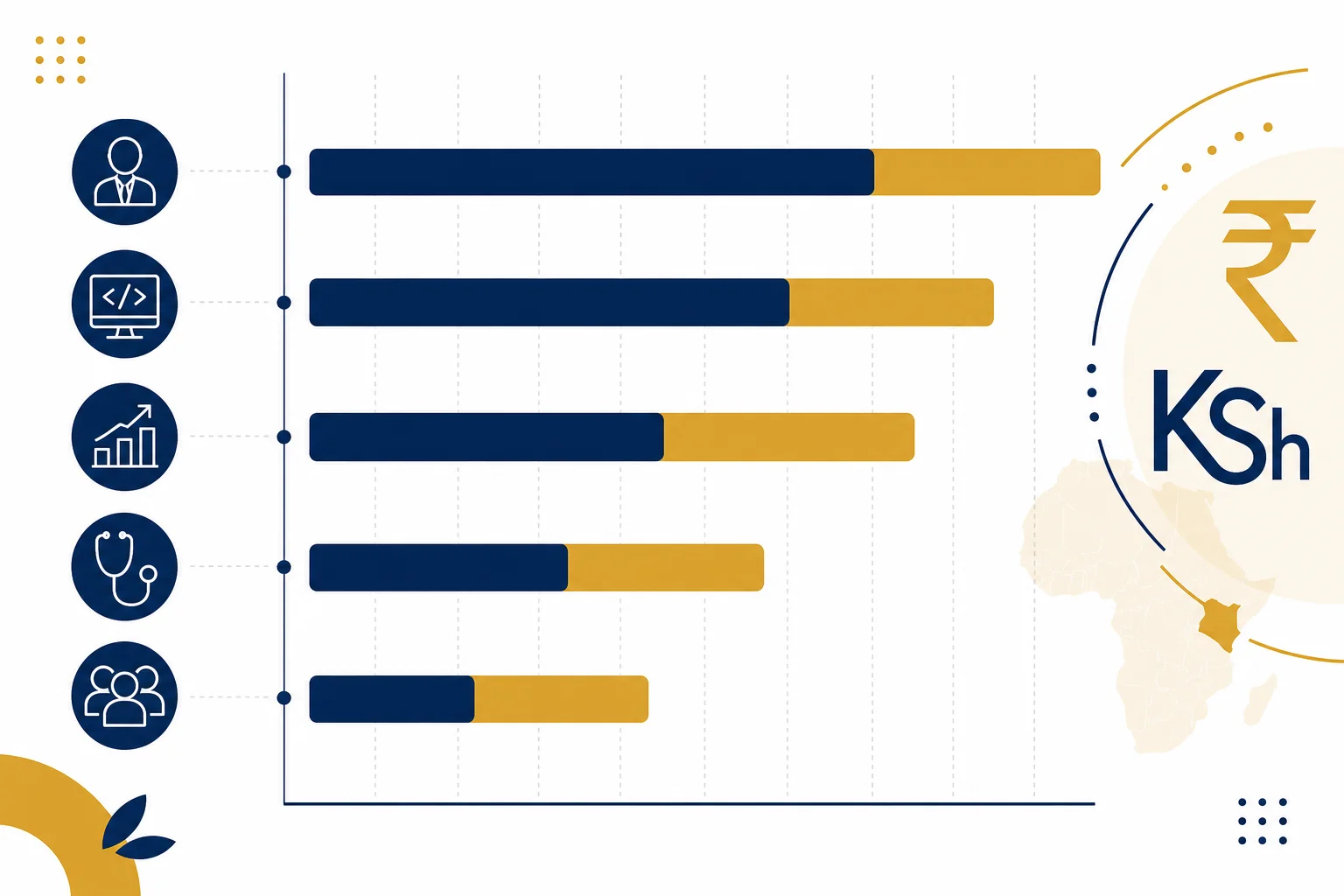
These are approximate 2026 market ranges for Nairobi-based professionals. Salaries in Mombasa and other cities typically run 10-20% lower. All figures are gross monthly salary. The INR equivalents use an approximate rate of 1 KES = 0.63 INR, verify the current rate before finalising offers.
| Role | KES/month (gross) | Approx. INR/month | Bonus/Equity |
|---|---|---|---|
| Software Engineer (mid-level) | KES 120,000, 200,000 | ~INR 75,000, 1,26,000 | 5-10% annual bonus; equity rare outside funded startups |
| Sales Manager | KES 150,000, 250,000 | ~INR 94,000, 1,57,000 | Commission-heavy; OTE can add 20-40% on top of base |
| Operations Manager | KES 130,000, 220,000 | ~INR 82,000, 1,38,000 | 5-12% annual bonus typical |
| Finance Manager | KES 140,000, 230,000 | ~INR 88,000, 1,45,000 | 5-10% annual bonus; CPA/ACCA holders command the upper band |
| Country Manager | KES 350,000, 600,000 | ~INR 2,20,000, 3,78,000 | 10-20% bonus; housing allowance common for expat hires |
Gross vs. net: Kenya's PAYE (Pay As You Earn) tax is graduated, reaching 35% on income above KES 800,000/month. For most mid-level roles, effective tax rates run 20-28%. Candidates will negotiate on net take-home, not gross, factor this into your offer conversations. On top of gross salary, employers add approximately 18-22% for statutory contributions and benefits (detailed in Section 11).
For a broader view of how Kenya fits into your multi-country hiring strategy, the Global Hiring from India: The 2026 Complete Guide covers the full framework Indian companies use when expanding headcount across multiple geographies simultaneously.
Kenyan hiring timelines are reasonable by global standards, but they have specific pressure points that catch Indian companies off guard.
The hidden timeline killer is slow internal decision-making. Top Kenyan candidates, particularly in tech and finance, hold multiple offers simultaneously. A hiring process that takes more than three weeks from first interview to offer will lose candidates to faster-moving employers. The hidden cost of roles left open is just as real in Nairobi as it is in Bengaluru.
Kenya has the strongest talent pool in East Africa. Nairobi is the region's undisputed commercial, technology, and financial services hub, and that concentration of talent is a genuine advantage for Indian companies hiring here.
The University of Nairobi, Strathmore University, and USIU-Africa produce strong graduates in engineering, business, IT, and finance. Kenya also has a growing cohort of professionals who have worked for multinationals or studied abroad and returned, a profile that suits Indian companies looking for global-standard talent with local market knowledge.
The unemployment rate nationally sits at approximately 12-15%, but that figure is misleading for skilled hiring. Qualified software engineers, finance managers, and operations leaders in Nairobi are in genuine demand. Safaricom, Google, Microsoft, Unilever, Standard Chartered, and a large NGO/development sector all compete for the same talent pool. Offering below-market salaries or a slow process will cost you candidates to these employers.
Kenya has an Indian-origin community of approximately 100,000 people, with deep roots in trade, manufacturing, and professional services. This diaspora creates a useful cultural bridge for Indian employers, familiarity with Indian management styles, business practices, and communication norms is higher in Kenya than in most African markets. It also means some candidates may have direct experience working with Indian-founded companies.
The best candidates in Kenya are not browsing job boards. They are employed, performing well, and open to the right opportunity, but only if it reaches them. This is why specialist recruiters with active Kenyan networks consistently outperform job board postings for mid-to-senior roles. Job boards vs. agencies vs. AI marketplaces, the comparison holds in Kenya just as it does in India.
Kenya's professional culture is formal, relationship-oriented, and English-fluent, a combination that makes it genuinely accessible for Indian hiring teams.
Kenyan professionals are direct in written communication but tend toward formality in initial interactions. Titles and surnames are used until a relationship is established. Hierarchy is acknowledged, candidates will be respectful of seniority, but collaboration and being heard are also valued. Flat, dismissive management styles do not land well.
Structured panel interviews are well-received and expected at mid-to-senior levels. Case studies and scenario-based questions are common in consulting, finance, and operations roles. Video interviews (Zoom, Teams) are fully normalised, Nairobi's professional class is comfortable with remote hiring processes. Expect candidates to come prepared with questions about growth, culture, and the company's regional presence.
Generally positive. The Indian business community has a long history in Kenya, and Indian management styles, structured, process-driven, metrics-focused, are familiar to many Kenyan professionals. Direct feedback is appreciated; vague or evasive communication frustrates candidates and signals disorganisation.
Candidates disengage when: the process takes more than 3, 4 weeks without clear milestones; the salary offer is below the range discussed at screening; the job scope changes between interview and offer; or the hiring team is unresponsive for more than five business days. These are not Kenya-specific issues, but they are amplified in a competitive market where candidates have options.
Kenya scores 3 out of 5 on payroll and compliance complexity for foreign employers, moderate, not severe. Here is the breakdown:
| Dimension | Score (1=simple, 5=complex) | Key Detail |
|---|---|---|
| Tax (PAYE) | 3/5 | Graduated scale up to 35%; employer must register with Kenya Revenue Authority (KRA); monthly PAYE remittance required |
| Social / Pension (NSSF) | 2/5 | National Social Security Fund contributions currently KES 200/month (flat rate under review for reform); straightforward but watch for legislative changes |
| Health Insurance (NHIF) | 2/5 | National Hospital Insurance Fund; employer and employee contributions; being restructured under the Social Health Authority (SHA) reforms, verify current rates with local counsel |
| Payroll Cycle | 2/5 | Monthly payroll is standard; must be processed and paid before month-end; penalties for late remittance |
| Data Privacy | 3/5 | Kenya Data Protection Act 2019 requires employee consent for processing personal data; cross-border data transfers need safeguards; enforcement is increasing |
| Background Checks | 3/5 | Criminal record checks permitted via Directorate of Criminal Investigations; credit checks require employee consent; blanket medical checks are not permitted |
Overall verdict: Kenya's compliance environment is manageable for a mid-market Indian company with a local payroll partner or EOR. The main watch points are the ongoing NHIF/SHA reform (rates and structure are in transition), the Data Protection Act (relatively new and enforcement is growing), and KRA's increasing scrutiny of contractor arrangements. None of these are deal-breakers, they just require local expertise rather than a DIY approach.

Most Indian companies hiring in Kenya for the first time face the same sourcing problem: their existing agency panel has no Kenya coverage, job boards surface only active candidates, and building a local recruiter relationship from scratch takes months they do not have.
CBREX solves this through its network of 4,000+ specialist recruiting firms across 33 countries, accessible through a single contract and a single invoice. When a Kenya role is posted on the CBREX platform, the AI vendor matching engine (C Map) routes it to the most relevant specialist agencies with active Kenyan networks, rather than generalist firms guessing at the market.
CBREX's strongest sector coverage in Kenya aligns with where Indian companies most commonly hire: Healthcare, Pharma, IT, and Manufacturing. For Indian pharma and manufacturing companies expanding into East Africa, this is particularly relevant, the same specialist networks that fill niche roles in India and Southeast Asia extend into the Kenyan market.
The single-contract model also eliminates the vendor management overhead that makes multi-country hiring painful. One agreement, one invoice, one point of contact, whether you are hiring in Nairobi, Bengaluru, or both simultaneously. For TA leaders managing multi-geography hiring from India, that consolidation is not a minor convenience, it is a structural advantage.
If you are evaluating whether CBREX fits your Kenya hiring needs, the fastest way to find out is a direct conversation with a specialist. Book a Demo and walk through your specific roles, timelines, and market requirements with a CBREX specialist who covers East Africa.
These are the errors that consistently slow down or derail Kenya hiring for Indian companies, most of them avoidable with the right preparation.
The RPO vs Agency model comparison is worth revisiting here, the same structural question applies when hiring in Kenya. A specialist agency with local Kenya coverage will consistently outperform a generalist RPO with no East Africa presence.
Understanding the true cost of a Kenya hire requires looking beyond gross salary. Here is the full employer cost picture for a mid-level Nairobi hire in 2026.
Traditional agency fees in Kenya run 15-20% of first-year gross salary. On a KES 180,000/month hire (approximately INR 1,13,000/month), that is KES 324,000, 432,000 (approximately INR 2,04,000, 2,72,000) as a one-time placement fee. CBREX's pay-on-hire model operates on a similar percentage basis, but with no retainer, no upfront payment, and no fee if no hire is made. For a detailed breakdown of how recruiter fees work across models, see Recruitment Agency Cost in India: What You're Really Paying, the same fee structures apply internationally.
For redundancy, Kenya requires 15 days' pay per completed year of service. This is not a day-one cost, but it should be factored into workforce planning for roles expected to last 2+ years.
For a local Kenyan hire (no relocation, no work permit), total employer cost typically runs 20-25% above gross salary when statutory contributions, benefits, and recruitment fees are included. For an expatriate hire, add work permit fees and relocation costs on top.
Use this checklist before your first Kenya hire goes live. Each step has a clear owner and a realistic timeline.
Ready to hire in Kenya? CBREX connects Indian companies to specialist recruiting firms across East Africa through a single contract, with no retainers and a 17-day average fulfillment timeline. Whether you need a Software Engineer in Nairobi or a Country Manager for your East Africa expansion, the process starts with one conversation. Book a Demo with a CBREX specialist and get your Kenya hiring moving today.
No. An Employer of Record (EOR) can employ staff on your behalf legally in Kenya without you needing a registered entity. This is the recommended route for fewer than 10 hires or engagements under 12 months.
No. Kenyan employees must be paid in Kenyan Shillings (KES) through a Kenyan payroll. Cross-border INR payments do not satisfy Kenyan employment law requirements and create tax complications for both parties.
Yes. English is an official language in Kenya and is the standard language for employment contracts, court proceedings, and business communication. No translation is required.
Approximately 6, 10 weeks from job brief to accepted offer for specialist roles, plus the candidate's notice period (typically 1, 3 months). Total time from brief to start date: 10, 18 weeks for senior hires.
Contractor misclassification. The KRA is actively scrutinising arrangements where contractors function as employees. Use an EOR or employ directly to avoid back-tax liability and penalties.
No. Kenya has no statutory 13th-month pay obligation. Year-end discretionary bonuses are common market practice but are not legally mandated.


