Read Time:
3 Mins

Consolidating 100+ Hiring Vendors into One Dashboard: An ROI Analysis for CFOs

By
CBREX

In the fiscal landscape of 2026, the "Growth at all Costs" era has been replaced by the "Efficiency at Scale" era. For the modern CFO, the recruitment department often represents a significant "black hole" of unoptimized spend. When an organization manages over 100 different hiring vendors, they aren't just hiring; they are managing a logistical nightmare that hemorrhages capital through administrative friction and inconsistent "success fees."

The Multi-Vendor Friction: A Hidden Tax on Growth

The traditional decentralized model—where different departments engage their own niche agencies—creates a "Hidden Tax." Every new vendor requires:

  1. Legal/Compliance Vetting: 10+ hours of legal review per contract.
  2. Finance Overhead: Individual invoice processing, tax compliance, and payment tracking for 100+ different entities.
  3. Data Fragmentation: No single source of truth for which agencies are actually performing, making "Performance-Based Budgeting" impossible.

Case Study: Global Logistics Leader Consolidation (500+ Hires/Year)

A Tier-1 Global Logistics firm specializing in automated supply chain solutions faced a crisis: they were working with 114 different recruitment agencies across 12 countries. Their talent acquisition spend was erratic, and their procurement team spent 30% of their month just reconciling invoices.

The Strategy: The CFO mandated a "Single-Pane-of-Glass" approach. They migrated all 114 vendors into a Recruitment Exchange. Instead of 114 separate relationships, they moved to a single contract model where requirements were distributed to specialized vendors based on proven performance metrics.The firm utilized ISO 27001 compliant data sharing through the exchange to ensure that candidate PII (Personally Identifiable Information) was protected across all 114 vendors.

The ROI Result:

Within two quarters, the firm reduced its Total Talent Acquisition Cost (TTAC) by 18%. More importantly, by using AI-driven allocation, they decreased their "Time-to-Productivity" for new hires, as the vendors provided higher-quality candidates vetted through standardized tools.

“Consolidation isn't just about reducing the number of vendors; it's about increasing the quality of data behind every hiring decision.”

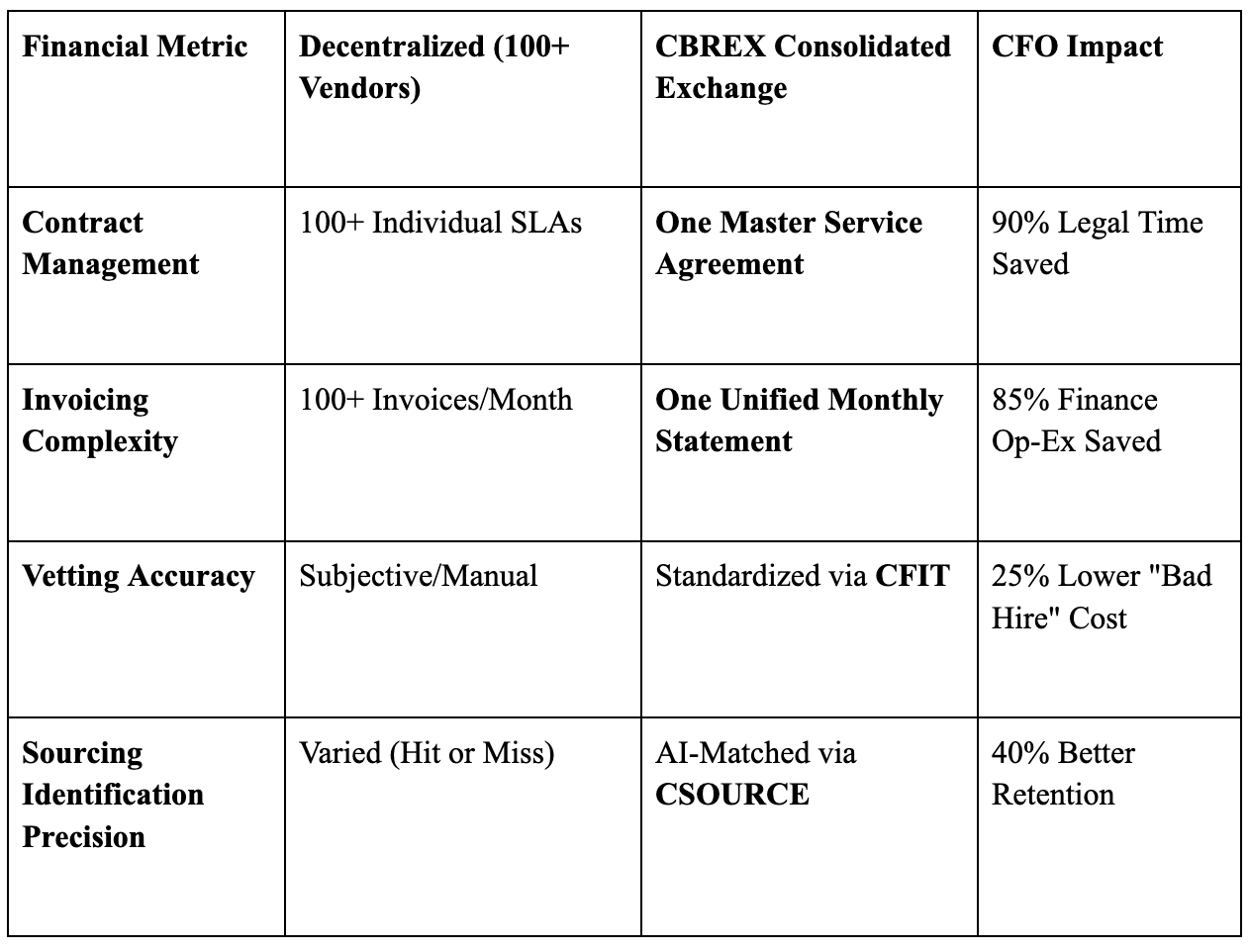
The ROI Breakdown: Traditional vs. Exchange Model

Data from 2026 enterprise benchmarks highlights the fiscal impact of consolidation via an exchange
The Bridge: Why "One Dashboard" is the Future of Procurement

Consolidation is not just about saving time; it’s about Data Sovereignty. When all hiring flows through a single exchange, the CFO gains real-time visibility into the "Cost-per-Lead" and "Interview-to-Offer" ratios across the entire organization.

This is the core value proposition of the CBREX model. By acting as the central nervous system for recruitment, CBREX allows an organization to keep its "Specialized Micro-Vendors" while eliminating the "Generalist Chaos." The client posts a requirement; the exchange handles the allocation to the best-performing vendor. Tools like CSOURCE find the talent, and CFIT ensures they align with the firm's specific ROI benchmarks. For the CFO, CBREX transforms recruitment from a variable expense into a predictable, optimized asset.
Table of contents

Sign up for regular updates
Get all the news delivered to your inbox.
Thank you! Your submission has been received!
Oops! Something went wrong while submitting the form.

Similar blogs

Read Time :
3 Mins
Why 'Ghosting' is a Data Problem: Solving Reliability in the Indian Tech Talent Market
Candidate ghosting has become a major challenge in the Indian tech talent market, especially for high-demand roles where professionals often juggle multiple offers. Traditional recruitment methods rely heavily on intuition and manual follow-ups, which fail to detect early signs of low candidate intent. AI-driven recruitment exchanges address this issue by analyzing engagement patterns, behavioral signals, and market data to predict candidate reliability. With predictive scoring and standardized skill validation, recruiters can prioritize high-intent candidates and significantly reduce last-minute dropouts, improving hiring efficiency and reducing costly delays.
Read Time :
3 Mins
The 2026 Global Hiring Compliance Map: Navigating EOR vs. Exchange-Led Sourcing in SE Asia
Expanding into Southeast Asia offers access to fast-growing talent markets but also introduces complex compliance challenges. Many companies rely solely on Employer of Record (EOR) services, assuming they cover both employment and sourcing. In reality, EOR manages payroll and legal employment, while sourcing and vetting compliant talent require local expertise. Recruitment exchanges solve this gap by connecting organizations with specialized local vendors who understand regional labor laws, data privacy regulations, and hiring practices. By combining AI-powered screening with hyper-local recruitment expertise, the exchange model enables companies to scale hiring across Southeast Asia faster while minimizing regulatory risk.
Read Time :
3 Mins
The Death of the 'Generalist' Agency: Why 2026 Demands a Recruitment Exchange Model
In 2026, AI has made finding candidates easier than ever — but hiring the right ones has become more complex. The traditional generalist recruitment agency model is struggling to keep up with the surge in applications and the need for deeper expertise. Recruitment exchanges are emerging as the new solution, combining specialized vendors with AI-powered filtering to deliver higher-quality candidates faster. By focusing on precision, technical validation, and structured screening, the exchange model helps companies reduce noise, improve offer acceptance rates, and make hiring more predictable.