Read Time:
3 Mins

AI in Passive Candidate Engagement: Reaching Talent Before They’re Looking

By
CBREX

Some of the best candidates aren’t actively applying — they’re passive. Finding and engaging these professionals has always been a challenge for recruiters. AI is quietly changing that, giving recruiters the insights and tools to reach top talent before roles even open.

A real-world example: connecting with passive talent

A fast-growing software company needed developers with rare skills. Traditional sourcing only reached active job seekers, leaving gaps in the candidate pool.

By using AI, the recruitment team could analyze career trajectories, skills, and professional activity across multiple platforms to identify passive candidates. AI highlighted the individuals most likely to be open to new opportunities, giving recruiters a curated shortlist to engage proactively.

The outcome? Faster access to highly qualified candidates, higher engagement, and stronger relationships — all without sacrificing recruiter control.

How AI supports passive candidate engagement

Recruiters leveraging AI in passive hiring report consistent benefits:

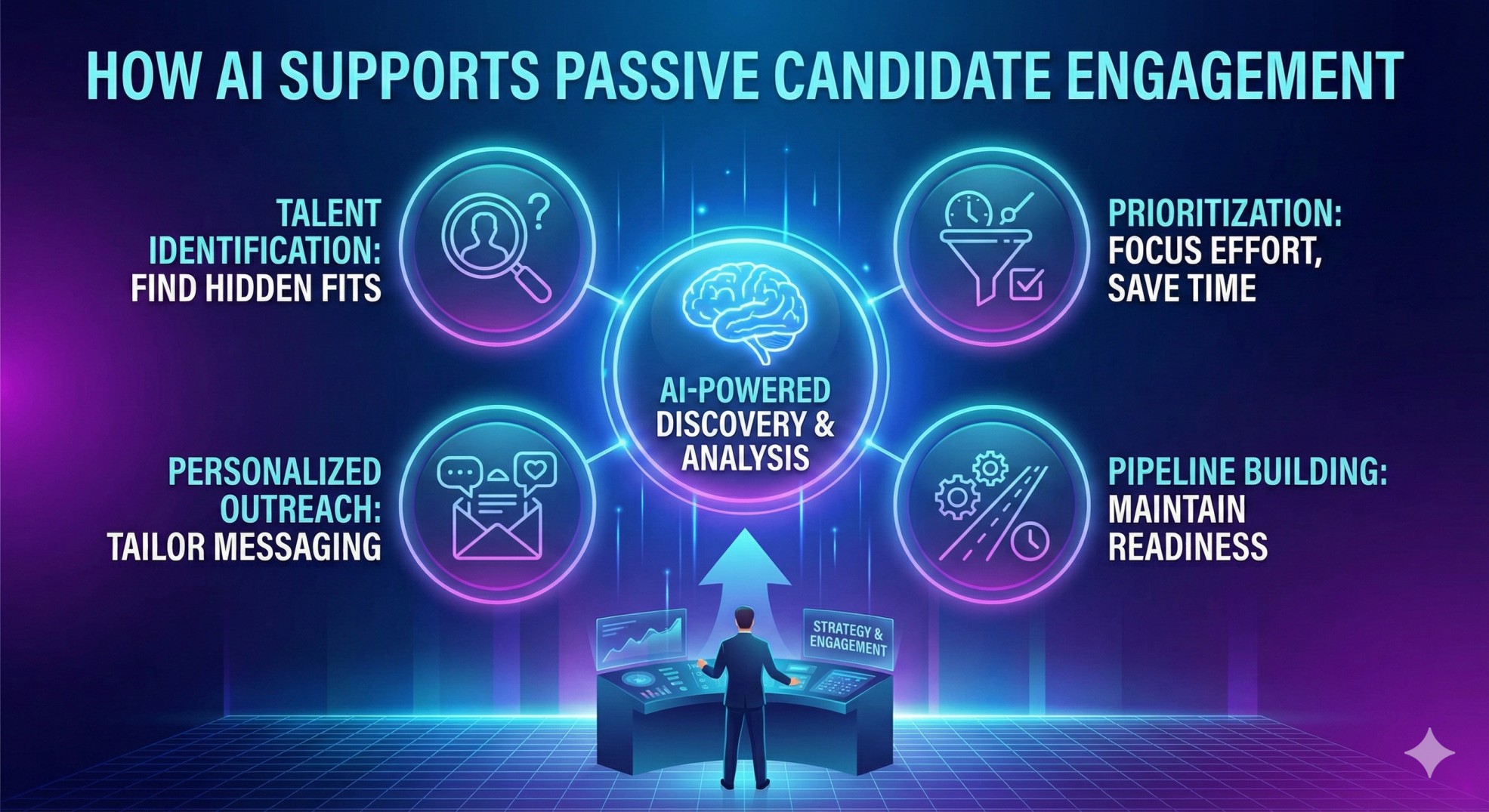
  • Talent identification: Find candidates who aren’t actively applying but fit the role perfectly.

  • Prioritization: Focus on those most likely to be receptive, saving time and effort.

  • Personalized outreach: AI helps suggest tailored messaging based on candidate profiles and interests.

  • Pipeline building: Maintain relationships over time, ensuring readiness when roles open.

AI handles discovery and analysis, while recruiters focus on strategy and engagement.
From reactive to proactive recruitment

With AI supporting passive talent engagement:
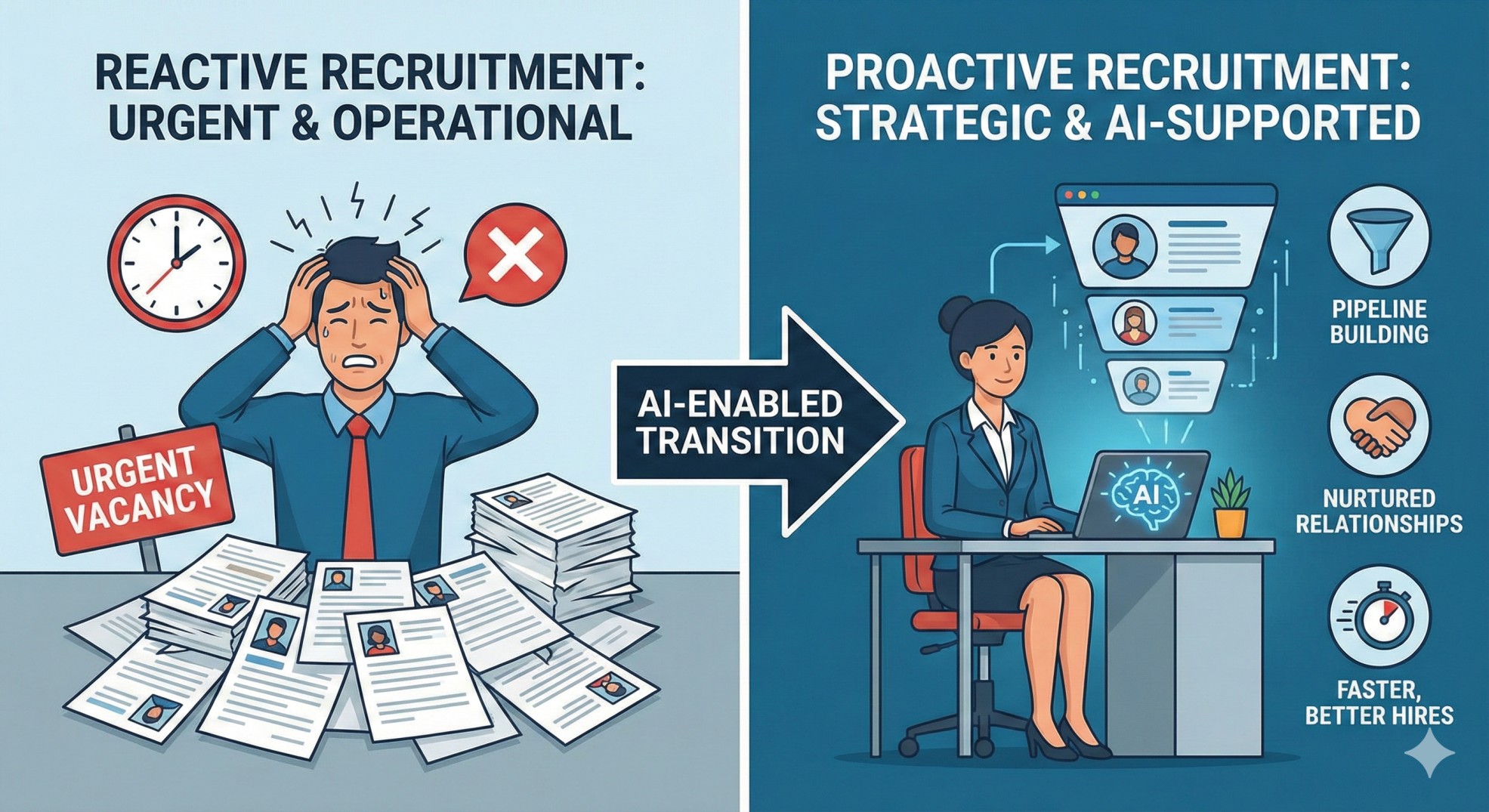
  • Recruiters can build pipelines before vacancies become urgent.

  • Candidate relationships are nurtured over time, improving employer brand perception.

  • Hiring managers receive better-qualified candidates faster.

  • Recruitment becomes strategic, rather than purely operational.

A quiet role for platforms in passive hiring

Platforms like CBREX provide the structure to surface passive talent and track engagement. AI identifies potential candidates and prioritizes outreach, but recruiters remain responsible for building connections, evaluating fit, and guiding the hiring decision.

The takeaway

The best talent isn’t always looking — but with AI, recruiters can find and engage them proactively.

By combining machine-driven insights with human relationship-building, recruitment becomes smarter, faster, and more human — ensuring that top candidates are never missed.

Table of contents

Sign up for regular updates
Get all the news delivered to your inbox.
Thank you! Your submission has been received!
Oops! Something went wrong while submitting the form.

Similar blogs

Read Time :
3 Mins
The Accuracy Arbitrage: Why Precision-Vetting is the Only Cure for 2026’s Resume Inflation
In 2026, AI-driven auto-applications have flooded the recruitment funnel, making it harder than ever to identify truly qualified candidates. Resume inflation means that many candidates appear perfect on paper but lack real-world expertise. Precision vetting is emerging as the solution, shifting recruitment from volume-based sourcing to accuracy-driven filtering. By combining technical validation and behavioral analysis, AI-powered recruitment exchanges help organizations cut through noise, verify candidate capabilities, and focus only on high-quality, high-intent talent—transforming hiring into a more efficient and reliable process.Executive Summary: As AI "agents" begin to auto-apply to thousands of roles simultaneously, the traditional recruitment funnel has collapsed under the weight of 5,000+ resumes per job. This post explores the Accuracy Arbitrage—the competitive advantage of using the CBREX exchange to replace "Volume-based" sourcing with High-Precision Filtering. The 2026 Crisis: The "Bot-Flood" and Resume Inflation If you posted a Senior Developer role today, you didn't just invite talent; you invited an army of bots. In 2026, Agentic AI tools can "perfect" a resume and apply to 500 jobs in under 60 seconds. This has led to Resume Inflation—where every candidate looks like a 10/10 on paper, but only 0.1% possess the actual technical depth required. For the modern HR leader, the cost of "Finding" has dropped to zero, but the cost of "Verifying" has skyrocketed. The Senior Insight: In a world of infinite noise, Accuracy is the only premium. The companies that win the talent war in 2026 aren't the ones who see the most resumes; they are the ones who see the right five. How can enterprises use precision-matching to eliminate AI-generated application noise? To beat the "Bot-Flood," you cannot use a bigger bucket (more recruiters); you need a finer mesh (better data). Precision-matching requires a shift from Keyword Recognition to Proven Capability. The CBREX exchange model solves this by utilizing Accuracy & Precision as its core architecture. Instead of a generalist algorithm, the exchange routes requirements to specialized micro-vendors who possess the "Human-in-the-Loop" expertise to spot an AI-hallucinated skill set from a mile away. The Precision Filter: CSCREEN & CPREDICT While job boards offer "matches," CBREX offers "Guaranteed Signal." CSCREEN (The Technical Anchor): This isn't just a quiz. It’s a high-precision validation layer that uses live environment testing to ensure a candidate’s "Rust" or "Cybersecurity" expertise is real. CPREDICT (The Intent Anchor): It analyzes behavioral data to distinguish between a "Bot-Applied" candidate and a "High-Intent" professional. It predicts the likelihood of the candidate actually showing up for the interview. Volume vs. Veracity: The 2026 Benchmarks Data from the CBREX exchange highlights why "Accuracy" is the ultimate ROI lever.
Read Time :
3 mins
How AI-Powered Vendor Matching Reduces 'Time-to-Shortlist' by 40%
In competitive technical hiring markets, speed is critical. The most important recruitment metric today is no longer time-to-fill but time-to-shortlist — the speed at which qualified candidates reach hiring managers. Traditional agencies often rely on manual database searches, which slows down the process and results in outdated candidate matches. AI-powered recruitment exchanges solve this challenge by instantly matching job requirements with specialized vendors who already have access to relevant talent pools. Combined with automated sourcing and technical validation tools, this model dramatically reduces the time needed to produce high-quality candidate shortlists.
Read Time :
3 Mins
Why 'Ghosting' is a Data Problem: Solving Reliability in the Indian Tech Talent Market
Candidate ghosting has become a major challenge in the Indian tech talent market, especially for high-demand roles where professionals often juggle multiple offers. Traditional recruitment methods rely heavily on intuition and manual follow-ups, which fail to detect early signs of low candidate intent. AI-driven recruitment exchanges address this issue by analyzing engagement patterns, behavioral signals, and market data to predict candidate reliability. With predictive scoring and standardized skill validation, recruiters can prioritize high-intent candidates and significantly reduce last-minute dropouts, improving hiring efficiency and reducing costly delays.